

Cultured Guru Logo
Cultured Guru Logo
  • Start Here
  • RecipesWe love to create delicious recipes with gut health in mind. By using our recipes, you can easily create any dish knowing that it’s good for gut health! Our recipe blog also includes Vegan Recipes, Vegetarian Recipes, Gluten Free Recipes, and Paleo Recipes.
  • About
  • Learn
  • Shop
  • Contact
  • Start Here
  • RecipesWe love to create delicious recipes with gut health in mind. By using our recipes, you can easily create any dish knowing that it’s good for gut health! Our recipe blog also includes Vegan Recipes, Vegetarian Recipes, Gluten Free Recipes, and Paleo Recipes.
  • About
  • Learn
  • Shop
  • Contact
Salads & Sides

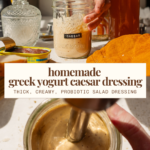
Homemade Greek Yogurt Caesar Salad Dressing

Forget store-bought dressings. Once you try this homemade Greek yogurt Caesar salad dressing, you’ll never go back! It’s super easy too, just throw all the ingredients in a wide mouth jar and blend.

Prep: 10 minutes
Total: 10 minutes
Jump to Recipe Rate Recipe
Recipe Index | Cook | Salads & Sides

Homemade Greek Yogurt Caesar Salad Dressing

Forget store-bought dressings. Once you try this homemade Greek yogurt Caesar salad dressing, you’ll never go back! It’s super easy too, just throw all the ingredients in a wide mouth jar and blend.

Greek Yogurt Caesar Salad Dressing

The first Caesar salad was made on July 4, 1924, by Italian Caesar Cardini at his restaurant in Tijuana, Mexico. The original recipe for the salad dressing didn’t have anchovies and used Worcestershire sauce for a distinct flavor. Eventually, the salad and dressing spread across the US and became among the most popular. Today, it’s still considered one of the all-time most popular salad dressings in the US. My version is a homemade Greek yogurt Caesar dressing, and I like to use both Worcestershire and anchovies for the best flavor.

Ingredients and Equipment

For best results, use the ingredients exactly as listed in the recipe. Especially the thick yogurt. This can be homemade yogurt you’ve strained through cheesecloth or a yogurt strainer, or store-bought yogurt. For store-bought, I highly recommend using Skyr or Greek, and Siggi’s is a great brand for thick, thick yogurt.

The only special equipment I recommend, and I recommend this for all salad dressings, is a stick blender. I think if you frequently make salad dressings at home, having a stick blender is a fantastic kitchen asset.

Yogurt Strainer

Yogurt Strainer

Australian Sea Salt

Australian Sea Salt

skyr yogurt starter culture package with cartoon art of yogurt on it

Skyr Yogurt Starter Culture

a yellow, orange, blue and green plastic lid product image

Regular Mouth Rust Proof Mason Jar Lids

KitchenAid Hand Blender

KitchenAid Hand Blender

Do you have to use anchovies?

I think so. The anchovy flavor makes for the best Caesar salad dressing. If you prefer not to use anchovies packed in oil, you can substitute anchovy paste. I put the substitution amount in the recipe card. For my recipe at 1x, you only need three anchovies. So if you are using canned anchovies, you will have some left over. The good news is you can freeze the leftovers. To freeze, I keep them in the oil and put them in a tiny glass Tupperware with an air-tight lid. They last in the freezer for about 2 months, and you can thaw them to use in your next batch of dressing.

Print
Salads & Sides

5 Stars 4 Stars 3 Stars 2 Stars 1 Star

No reviews

Homemade Greek Yogurt Caesar Salad Dressing

Forget store-bought dressings. Once you try this homemade Greek yogurt Caesar salad dressing, you’ll never go back! It’s super easy too, just throw all the ingredients in a wide mouth jar and blend.

  • Prep: 10 minutes
  • Total Time: 10 minutes

Ingredients

  • 1/3 cup thick yogurt (Greek or Skyr)
  • 1/3 cup Parmigiano Reggiano cheese, grated
  • 2 tablespoons vinegar
  • 3 tablespoons olive oil
  • 1/4 teaspoon garlic powder
  • 3 anchovies packed in oil and salt (or 2 tsp anchovy paste)
  • 1 teaspoon Dijon mustard
  • 1 teaspoon Worcestershire sauce
  • 1/4 teaspoon cracked black pepper
  • 1/4 teaspoon kosher salt

Instructions

  1. Add all the ingredients to a wide mouth jar. This recipe makes about one cup of dressing so a 16 oz mason jar works great.
  2. Using an immersion (stick) blender, pulse until fully combined and smooth. (You can also blend the dressing in a food processor if you don’t have a stick blender)
  3. Store the dressing in an airtight bottle in the refrigerator until ready to serve, or for up to 4 days.
  4. If you love this easy recipe, please leave a five-star review below!

Did you make this recipe?

Please leave a 5-star review below if you loved it! Tag @cultured.guru on Instagram


Nutrition information is auto-calculated and estimated as close as possible. We are not responsible for any errors. We have tested the recipe for accuracy, but your results may vary.

author avatar
Kaitlynn Fenley Author, Educator, Food Microbiologist
Kaitlynn is a food microbiologist and fermentation expert teaching people how to ferment foods and drinks at home.
See Full Bio
fermentation food microbiology sourdough sauerkraut fermenting at home fermented foods fermented drinks
social network icon social network icon social network icon social network icon

welcome!

hey i’m kaitlynn, i’m a microbiologist and together with my husband jon we are cultured guru.

more about us

let’s connect!

newest recipe

Fermented Horseradish Pickles with Dill and Garlic
Fermented Pickles

Fermented Horseradish Pickles with Dill and Garlic

never miss a thing

learn more about microbes from a microbiologist
Loading

on pinterest

Instant Pot Vegan Chicken Noodle Soup
Sourdough Smores Cookies
High Protein Cottage Cheese Mac and Cheese
Sourdough & Miso Chicolate Chip Cookies
Sourdough Dinner Rolls
Homemade Cottage Cheese

top rated recipes

How to Make Moroccan Preserved Lemons with Sea Salt
Fruits & Roots

How to Make Moroccan Preserved Lemons with Sea Salt

Slow Cooked Pork Roast with Sauerkraut Potatoes and Carrots
Protein

Slow Cooked Pork Roast with Sauerkraut Potatoes and Carrots

Sparkling Golden Beet Kvass Made the Traditional Way
Beverage Fermentation

Sparkling Golden Beet Kvass Made the Traditional Way

learn more

Understand microbes and master fermentation with our online courses!

learn

rate and review
We would love to hear what you think!
Cancel reply

Your email address will not be published. Required fields are marked *

Recipe rating 5 Stars 4 Stars 3 Stars 2 Stars 1 Star


you may also like

Salads & Sides View Recipe

Fall Harvest Salad with Maple Dijon Dressing

Salads & Sides View Recipe

Warm Brussel Sprout Caesar Salad with Chicken and Parmesan

Salads & Sides View Recipe

Roasted Chickpea Caesar Salad with Vegan Parmesan

join us on insta

@cultured.guru

Gosh I hope I pronounced Giardiniera correctly. 🤗 Gosh I hope I pronounced Giardiniera correctly. 🤗 

This jar I made was in my fridge for over six months, and it was time to do something with it. When I don’t know what to do with a ferment, pasta salad is usually the answer!

Get the recipe from the link in my bio! #pasta #salad
Healthy poop potion? I really do think my gut is Healthy poop potion?

I really do think my gut is loving this sauerkraut because of the celeriac (celery root), and I don’t have a science based reason for why. I saw this celery root in the store and had a gut feeling that I should make sauerkraut with it, and that’s how we got here. I guess my microbiome knew what it wanted!

Type “root vegetable sauerkraut -ai” into google and you’ll see my recipe! It’s also on my website homepage, also linked in my bio, and if you’re seeing this on Facebook, link is in the comments. Enjoy!  #sauerkraut
A lot of people think vinegar kills all microbes b A lot of people think vinegar kills all microbes because shelf stable pickles do not contain microbes. But with shelf stable pickles, it’s the pasteurization/sterilization via hot water bath or pressure canning that makes shelf stable pickles free of microbes.

Hot hot hot acid in a pressurized environment does kill, well…most microbes. 

Think about “refrigerator pickle” recipes, though. They need to be stored in the refrigerator because vinegar alone doesn’t stop fermentation.

Fridge pickles are made without pasteurization/sterilization (canning) so they will wild ferment without refrigeration, and not necessarily in a good way because there’s not enough salt. 

All vinegar is made via fermentation too, and vinegar fermentation involves acetic acid bacteria, but also a ton of LAB, mainly Lactobacillus, Pediococcus, and Leuconostoc (the same genera you’d find in fermented veg.)  I linked a reference paper in my fermented mushroom recipe blog, so you all can read about the LAB involved in vinegar fermentation. 

Try 🍄‍🟫googlin’🍄‍🟫“fermented mushrooms” and you’ll see my recipe, it’s the first result (usually) 🤗

#mushrooms #fermentation
I will not ever wild lacto ferment just beets agai I will not ever wild lacto ferment just beets again lol. Mixing with cabbage for beet sauerkraut is the best though! 

“Lacto fermented beets” was the first ferment I tried to make after learning sauerkraut in college. My best friend Sidney came over and we used these gorgeous beets from the farmers market, with 2.5% salt, and some spices. Well, it ended up tasting like beet moonshine and it was just… not good.

But it was a conduit for learning. Those beets were my first lesson in how different sugars and growth in the rhizosphere vs the phyllosphere influences fermentation. 

Cabbage and the cabbage microbiome offer a lot to balance out beets in fermentation, and I think mixing into a sauerkraut is the only way to go for lacto fermenting beets! 

Try googlin’ “beet and red cabbage sauerkraut” and you’ll see my recipe, I’m Cultured Guru.
Squash is the secret ingredient! My Roasted Butte Squash is the secret ingredient!

My Roasted Butternut Squash Hot Sauce recipe is free on my website! I didn’t cook this one, so yes it’s still probiotic.

When lactic acid bacteria ferment the starches in winter squash, they naturally convert them into emulsifying compounds called exopolysaccharides. So when we blend our hot sauce after fermentation, there’s no watery separation in the bottle. Roasting the squash with the garlic for the recipes also adds such good flavor! 

Definitely make sure it’s fully fermented and not bubbling anymore before you blend and bottle. Otherwise, it’ll carbonate in the cute little hot sauce bottles.

#hotsauce
Myth Busting: Yes, the SCOBY IS the pellicle! Plee Myth Busting: Yes, the SCOBY IS the pellicle! Pleeeease stop saying it’s not. 😌


Watch till the end, I show you how to grow one!


This is a little tidbit from what I teach in the Kombucha lesson in our Fermented Drinks Semester online course!

I also share this recipe FOR FREE just ✨GOOGLE✨ “cultured guru SCOBY” and you’ll see my full recipe with the perfect sugar to tea ratios for growing, feeding and maintaining a kombucha SCOBY.

#kombucha
Flower Icon
LEARN ABOUT MICROBES FROM A MICROBIOLoGIST
Loading

recipes

  • Sourdough
  • Sauerkraut
  • Yogurt & Kefir
  • Pickles
  • Sweets & Snacks

more

  • Start Here
  • About
  • Learn
  • Shop
  • Contact

social

  • TikTokVisit Cultured Guru TikTok Account
  • InstagramCultured Guru Instagram Account
  • PinterestVisit Cultured Guru’s Pinterest Account
  • FacebookVisit Cultured Guru’s Facebook page
  • Privacy & Terms
Footer Logo
Footer tagline
copyright

©2026

Cultured Guru

.

website by saevil row + MTT. all rights reserved.