


The Best Pickled Red Onions
The way I ferment red onions is different from the way I usually ferment other vegetables. I’ve done quite a few fermented red onion recipe tests using traditional wild fermentation techniques, and I wasn’t too fond of them. So I turned to my other favorite method of fermentation called wild heirloom culturing. This method employs using fermented sauerkraut brine (or any fermented vegetable brine; brine is the liquid in a jar of already fermented vegetables) and apple cider vinegar to ferment fresh vegetables using wild heirloom cultures found in the fermented brine.
This method of fermentation is more similar to yogurt fermentation than it is to something like sauerkraut fermentation… and it’s very similar to refrigerator pickling, but with beneficial microbes included.

Lacto Fermented Red Onions
I know you may be curious why the traditional lacto fermentation process isn’t great for fermenting onions.
Basically, you don’t want to wild ferment any vegetables that are high in fructose and fructans because it leads to more effervescent alcohol fermentation. This is true no matter how much salt you use.
If you can dump already acidic brine with a lot of Lactobacillus present, you can skip the first two stages of wild fermentation (you know, the part with all the bubbles). Lactobacillus bacteria only make lactic acid; they can’t make alcohol. So the onions still ferment, but only the desirable fermentation occurs.

Making Fermented Onions
Supplies You Need:
- 16 oz Wide Mouth Mason Jar
- Fermentation Weight to fit your mason jar
- Standard Metal Mason Jar Lid (this can rust in the presence of salt)
- OR Rust Free Plastic Lid
- Unrefined Sea Salt
- Scale
- Mixing Bowl
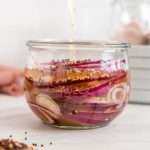
- or you can use a Weck Jar (which is what is pictured here)
Fermented Red Onions
We will still ferment red onions in this recipe, but this is a different kind of vegetable fermentation: We call this wild heirloom culturing. I made it up one day, and it’s phenomenally delicious. We use wild-fermented sauerkraut brine and apple cider vinegar to culture the onions with wild Lactobacillus. This method only requires a 24-hour fermentation time before refrigerating, but you can let it go for up to 48 hours before refrigerating.
Always trust your sense of smell: Fermented onions should smell pleasantly sour and oniony. Never eat anything that smells repulsive.
Never eat anything that has mold growing on it: By following directions, you should not encounter this problem. The effectiveness of this recipe does depend on the quality of wild fermented sauerkraut you use. If sauerkraut is not fermented correctly or to completion, you may encounter effervesce or yeast growth over time.
Taste test at 24 hours: If you prefer the onion to be more tart and sour, let them ferment for 12-24 more hours before refrigerating.
Apple Cider Vinegar Pickled Onions
These fermented quick-pickled red onions are very easy to make, and since they are made with already fermented vegetable brine and apple cider vinegar, not much can go wrong. You just need to remember a few things:
- Keep your fermenting red onions between 70-80 degrees F. Keep out of direct sunlight
- Since this is a fermentation with added cultures from the sauerkraut brine, you only need to ferment the onions for a short time.
- Keep it refrigerated and consume it within 6 months for full probiotic benefits!

Inspired By Mexican Pickled Red Onions
I also use lime juice in this recipe, giving it a flavor profile similar to Mexican pickled red onions. The pickling process with the lime juice mellows the intense flavor of the red onions. They are flavorful and balanced with a pleasant acidity in just a few hours.
Recipes with Pickled Onions
Here’s a short list of some of my favorite recipes you can use these fermented quick-pickled red onions in:
- No-Mayo Roasted Garlic and Herb Potato Salad
- Summer Lemon Kale Salad with Brined Salmon
- Easy Greek Meatballs with Tzatziki Sauce Dressing
- Nutritious Chicken Caesar Salad with Brussels Sprouts

Fermented Quick Pickled Red Onions
How do you quick pickle and ferment red onions at the same time? Easy, you just need sauerkraut brine, apple cider vinegar, lime juice and some thinly sliced fresh red onions!
- Prep: 10 minutes
- Total: 10 minutes
Ingredients
- 200 Grams Chopped Red Onion
- 5 Grams Sea Salt
- 100 Grams Raw Apple Cider Vinegar
- 200 Grams Sauerkraut Brine
- the juice of one small lime
- Mustard Seeds or peppercorns
Instructions
- Wash your fermentation equipment (jar, weight and lid)
- Peel then wash your red onions in cool water. Using a knife, slice your onion to desired thickness.
- Place your kitchen scale on the counter. Turn it on and set it to weigh in grams.
- Place a mixing bowl on your kitchen scale and tare/zero* the scale.
- Add chopped onion into the bowl on your scale until the scale reads 200 grams.
- Remove the bowl from your scale and set aside. Place your empty, clean mason jar on the scale, and tare/zero the scale. Make sure your scale is still set to grams and add 200 grams of Sauerkraut Brine and 100 grams of apple cider vinegar to the jar. Add the juice of one small lime
- Add the 200 grams of onions from your bowl, into the mason jar.
- Place a small bowl on your scale and tare/zero the scale. Weigh out 5 grams of salt. Then add the 5 grams of salt to the jar of onions.
- Add in about a teaspoon of mustard seeds or peppercorns (optional).
- Place your standard mason jar lid on the jar, and secure. shake the jar vigorously for 2 minutes.
- Leave at room temperature for 8 to 24 hours, stirring the onions a couple of times, then refrigerate.
- Refrigerate for at least 1 hour before serving.
Notes
*Taring/zeroing the scale with a container on it subtracts the weight of the container, allowing you to weigh only what is added to the container. After taring/zeroing the scale, the scale should read 0.0 with the container on it.
this recipe works best with a 16-20 ounce jar









Does using vinegar in this recipe kill the beneficial bacteria?
No, the beneficial bacteria thrive in acidic conditions.
Hello. A great recipe thank you, I love fermenting but adore vinegar Ed onion and pickles, so a great combo. Is there an alternative to the sauerkraut brine? I have whey from milk kefir, could I substitute with that please.
You’re welcome! The only alternative is brine from other fermented vegetables, like pickles or kimchi.
You cannot use whey from milk kefir for this type of fermenting because milk kefir contains yeast.
Your great!!
Does the ACV HAVE to be raw? I only have regular ACV on hand.
No, it does not have to be raw. The regular will work fine.
Hi this differs slightly from the low sodium recipe you have for carrots. You put the jar in the fridge to ferment for 48 hours as apposed to 48 hours for this recipe before refrigeration. How does this change the end product when comparing both techniques? Does the additional salt in this recipe effect the fermentation or is it for taste?
Hello,
Where can one obtain sauerkraut brine ?
Thank you,
Carolyn Gamboa
It’s the liquid in a jar of homemade or store bought fermented sauerkraut.
Is there anything you can use inflate of saurkraut brine?
Fermented pickle brine is also a good option.
Where can I purchase it bag gorgeous jar featured in the video?
The jar is linked in the body of this blog post. In the equipment list.
Thanks for the recipe. Going to try it later today. I understand (or at least think I do) the precise ratios of brine, acv and salt but…Why is it 200g of onions?
Because all the ingredient measurements are precise. I write all my fermentation recipes in grams, requiring a kitchen scale.
This recipe was a hit! I’m wondering if I can reuse the brine from the first time I made this recipe without adding the ACV? Or do I use the brine and still add ACV? Or am I not able to use this brine at all?
You can re-use it about twice before it becomes less acidic and not good for preserving the onions. When you reuse the brine from the previous batch, add more ACV.
Can I use beet brine instead of sauerkraut brine?
No, it needs to be sauerkraut brine.
I’m experienced in fermenting cauliflower. Can I use the brine from my cauliflower fermentation process instead of sauerkraut juice? I also use kosher salt. May I use that instead of the sea salt?
yes and yes 🙂
Hello,
I have some kimchi brine and some sauerkraut brine but not 200 grams of either. Can I combine the two to get a total of 200 without ruining the recipe or the process?
Thanks
Yes! You can combine them. I bet it will be delicious!
Had a few issues. First of all, I made the Saurkraut from your site in preparation to make this recipe. I didn’t realize until I was already making this recipe that I would have needed 2 jars of Saurkraut because I only had 100 gram worth from 1 batch. I used water to sub. Is that Ok?
The second issue is that my 16 ounce mason jar overflowed at 500 grams so the spice and lime weight sent it spilling over. I pushed the onions and dumped out enough liquid to leave an inch of space at the top of the jar. Then reset the scale to 0 to ensure I added the right salt concentration. Hope this was the right move. Wondering if I somehow added too much of something or if my batteries are weak but I use my scale all of the time and rarely mess it up. I added 100 grams ACV, 200 brine (w/ water mixed in to bring to weight), 200 onions, 20 grams seeds, 37 grams lime.
I made this again because they were the best pickled red onions I have tasted. Plus a great way to use up the kraut juice in the bottom of a few containers. I also encountered the same problem as before. There is too much liquid for 16 ounce jar and I had 4 about ounces leftover that would not fit in the jar. Seeing how this is a pickle more than a ferment, I didn’t worry about that too much and just made an extra 8 ounce jar worth from the leftover brine and cut up as many red onions that would fit. The kraut brine really does add something different in a very good way. I wish I had more kraut brine but after we finish a jar we usually only have about 70 grams of brine leftover so it takes 3 jars before I have enough to make this recipe. Plus the color is just sooo beautiful!
Hi!
I’ve been long time looking for low fodmap onions, are these ones low fodmap? Have the Lactobacillus enough time to eat the fructans in 24/48 hours?
By the way, in the main text it says let it for 48 or 54 hours, but in the instructions section says just 24 hours, not sure wich one is the right one.
Thank you so much!
When I had fructan intolerance, these onions worked great for me. But everyone is different, you can let them sit at room temperature for longer if you want.
Hi Kaitlynn, thanks for the advice. I tried it and it’s amazing. I can’t wait three weeks for my new brine to make them again! And no fructans effects.
By the way, I’ve done a lot of yours recipes but I’m not sure about a white growth thing in cucumbers and peppers. It’s not a pellicle or sediment at the bottom but a white stripe on the side of the vegetables, what could it be?
Thank so much for sharing your knowledge.
Would the liquid from store-bought probiotic fermented red onions work for this recipe? Or would sauerkraut brine work better? Excited to try this!
That can probably work! I’ve only ever made them with sauerkraut, kimchi and pickle brine though.
Could you give imperial measurements? I get so frustrated trying to convert from metric, that I don’t even try metric recipes. Thanks.
I only have the recipe as written and did not test it with imperial measure. You can use google to convert if you’d like.
Could I replace them Lime with a lemon or orange?
yes!
Could you use liquid from store bought peperoncini?
If they’re fermented, it should work great!
Can you use whey in place on the sauerkraut brine?
I haven’t tried it, but it might work!