

Cultured Guru Logo
Cultured Guru Logo
  • Start Here
  • RecipesWe love to create delicious recipes with gut health in mind. By using our recipes, you can easily create any dish knowing that it’s good for gut health! Our recipe blog also includes Vegan Recipes, Vegetarian Recipes, Gluten Free Recipes, and Paleo Recipes.
  • About
  • Learn
  • Shop
  • Contact
  • Start Here
  • RecipesWe love to create delicious recipes with gut health in mind. By using our recipes, you can easily create any dish knowing that it’s good for gut health! Our recipe blog also includes Vegan Recipes, Vegetarian Recipes, Gluten Free Recipes, and Paleo Recipes.
  • About
  • Learn
  • Shop
  • Contact
Fermented Pickles

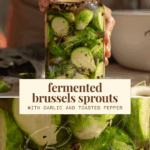
Fermented Brussels Sprouts with Garlic and Toasted Pepper

Fermented Brussels sprouts may smell like farts at first, but with two to three weeks of fermentation they transform into a delicious, sour, health promoting pickle.

Prep: 20 minutes
Total: 336 hours 20 minutes
Jump to Recipe Rate Recipe
Recipe Index | Ferment | Fermented Pickles

Fermented Brussels Sprouts with Garlic and Toasted Pepper

Fermented Brussels sprouts may smell like farts at first, but with two to three weeks of fermentation they transform into a delicious, sour, health promoting pickle.

Why Do Fermented Brussels Sprouts Stink?

These fermented Brussels sprouts smelled like farts for the first two weeks of fermentation. The smell is much more intense and stinky than sauerkraut. So, I had to put the whole jar in a Ziploc bag and burp the jar on the patio, so my kitchen wouldn’t smell completely awful.

But I swear these Brussels sprouts are still so worth fermenting and arguably one of the most beneficial vegetable ferments. The bad smell is actually from compounds that are incredibly good for you!

The Health Benefits

The fart smell is an excellent indicator that microbes are working to make the beneficial compounds in Brussels sprouts more bioavailable. The “stink” during fermenting comes from beneficial sulfur-containing compounds. Lactic acid bacteria convert glucoraphanin in Brussels sprouts into sulforaphane, and sulforaphane can smell quite bad. However, sulphoraphane is also an amazing health-promoting compound. It can reduce inflammation, may have anti-cancer effects, and supports cardiovascular, gut, and liver health.

Lactic acid fermentation is even being studied scientifically to enhance the production of sulforaphane from glucoraphanin in other cruciferous vegetables, such as broccoli. (source)

Fermented Brussels Sprouts with Toasted Peppercorns

For this recipe, I wanted to try something new with spices. I’ve been experimenting with toasting certain spices before using them in meals and recipes. So I figured why not try out toasting my spices for fermentation too! I pan toasted the peppercorns to bring out the flavors and essential oils before tossing them in the jar with the Brussels sprouts.

To toast peppercorns, add one tablespoon of whole peppercorns to a dry skillet (no oil) and toast over medium-high heat for 2-3 minutes, stirring constantly, until they become very fragrant. You may hear some of them pop, and that’s totally normal.

Things You May Need:

an empty Ball mason jar showing label

32 Oz Mason Jars

Australian Sea Salt

Australian Sea Salt

Plastic pH Test Strips (pH 0-14)

Plastic pH Test Strips (pH 0-14)

a yellow, orange, blue and green plastic lid product image

Regular Mouth Rust Proof Mason Jar Lids

Glass fermentation weights product picture

Wide Mouth Fermentation Weights

A kitchen scale top down showing the dual scale platforms and digital measurement screen

Kitchenaid Dual Platform Scale

How Long to Ferment Brussels Sprouts?

It takes at least 14 days to fully ferment Brussels sprouts. I really love the flavor best at about 21 days of fermentation, but any time between 14-28 days is great!

How to Eat Fermented Brussels Sprouts

There are many great ways to enjoy these fermented Brussels sprouts and here are some of my favorites:

  • Lightly chopped and added to pasta salad
  • They’re a great addition to any charcuterie board
  • This one will kill the beneficial microbes, but you can roast them and serve them as a side dish on Thanksgiving!
Print
Fermented Pickles

5 Stars 4 Stars 3 Stars 2 Stars 1 Star

5 from 2 reviews

Fermented Brussels Sprouts with Garlic and Toasted Pepper

Fermented Brussels sprouts may smell like farts at first, but with two to three weeks of fermentation they transform into a delicious, sour, health promoting pickle.

  • Prep: 20 minutes
  • Total Time: 336 hours 20 minutes

Ingredients

  • 320 grams Brussels sprouts, halved
  • 50 grams fresh garlic
  • 1 tablespoon black pepper corns, toasted
  • 400 grams water
  • 20 grams salt

Instructions

  1. This recipe at 1x works best with a 32-ounce wide-mouth jar. Please see the equipment recommendations above. Please use fresh Brussels sprouts (not “triple washed”).
  2. To toast the peppercorns, add one tablespoon of whole peppercorns to a dry skillet (no oil) and toast over medium-high heat for 2-3 minutes, stirring constantly, until they become very fragrant. You may hear some of them pop, and that’s totally normal.
  3. Wash all of your fermentation equipment (jar, weight and lid).
  4. Wash your Brussels sprouts in cool water.
  5. Slice all the Brussels sprouts in half, and slightly crush and peel the garlic cloves.
  6. Place your kitchen scale on the counter. Turn it on and set it to weigh in grams.
  7. Weigh out the designated amounts of all your ingredients.
  8. Add everything to the mason jar.
  9. Place the lid on the jar, and secure. Shake the jar vigorously for 2 minutes to dissolve all the salt.
  10. Remove the lid. Place your clean fermentation weight in the jar, making sure to submerge the Brussels sprouts, garlic, and weight fully in the liquid. (it’s okay if it’s not immediately submerged all the way, the sprouts will release more liquid over the next few hours)
  11. Secure the lid to the jar (you don’t need to tighten it significantly; just close it).
  12. Let the Brussels sprouts ferment for 14 days at room temperature. (I highly recommend placing the whole jar in a plastic zip bag to reduce bad smells! You can bring the whole bag outside to burp the jar). 
  13. If you tighten the lid a lot, you should burp the jar daily when it is bubbling. You can also open up the jar and check the lid. Rinse it with hot water if you see any stuck on spices or vegetable debris. 
  14. After 2-3 weeks, remove the fermentation weight and smell and taste test. Your fermented Brussels sprouts should smell pleasantly sour and taste tart and salty!
  15. Store in the fridge.

Did you make this recipe?

Please leave a 5-star review below if you loved it! Tag @cultured.guru on Instagram


Nutrition information is auto-calculated and estimated as close as possible. We are not responsible for any errors. We have tested the recipe for accuracy, but your results may vary.

author avatar
Kaitlynn Fenley Author, Educator, Food Microbiologist
Kaitlynn is a food microbiologist and fermentation expert teaching people how to ferment foods and drinks at home.
See Full Bio
fermentation food microbiology sourdough sauerkraut fermenting at home fermented foods fermented drinks
social network icon social network icon social network icon social network icon

welcome!

hey i’m kaitlynn, i’m a microbiologist and together with my husband jon we are cultured guru.

more about us

let’s connect!

newest recipe

Sourdough Discard Seed Crackers (fermented 48 hours)
Sourdough Discard

Sourdough Discard Seed Crackers (fermented 48 hours)

never miss a thing

learn more about microbes from a microbiologist
Loading

on pinterest

Instant Pot Vegan Chicken Noodle Soup
Sourdough Smores Cookies
High Protein Cottage Cheese Mac and Cheese
Sourdough & Miso Chicolate Chip Cookies
Sourdough Dinner Rolls
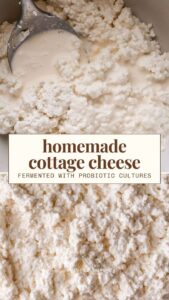
Homemade Cottage Cheese

top rated recipes

How to Make Moroccan Preserved Lemons with Sea Salt
Fruits & Roots

How to Make Moroccan Preserved Lemons with Sea Salt

Slow Cooked Pork Roast with Sauerkraut Potatoes and Carrots
Protein

Slow Cooked Pork Roast with Sauerkraut Potatoes and Carrots

Sparkling Golden Beet Kvass Made the Traditional Way
Beverage Fermentation

Sparkling Golden Beet Kvass Made the Traditional Way

learn more

Understand microbes and master fermentation with our online courses!

learn

rate and review
We would love to hear what you think!
Cancel reply

Your email address will not be published. Required fields are marked *

Recipe rating 5 Stars 4 Stars 3 Stars 2 Stars 1 Star


  1. Barbara Mulvey
    11|18|2025

    Would be interested to learn to make recipes for fermented vegetables and even fruit- do you also sell your own
    Fermented goods??

    Reply
    1. Kaitlynn Fenley
      12|03|2025

      We used to sell fermented foods, but now we’re solely dedicated to teaching. You can learn how to develop recipes and a more in depth understanding of fermentation in our online course! click here for the course

      Reply
  2. Kimberly Goff
    12|01|2025

    They sound wonderful. I’m about to travel, but will make them as soon as I get home.

    Reply
  3. Penny
    12|18|2025

    I am almost done with this recipe. I was wondering what the safe pH level for this recipe should be at the end of my 3-week fermentation.

    Reply
    1. Kaitlynn Fenley
      12|19|2025

      the pH should be below 4!

      Reply
  4. Misty
    01|06|2026

    These are awesome. So incredibly punchy. Will definitely make again!

    Reply
    1. Kaitlynn Fenley
      01|07|2026

      wonderful to hear that you like the fermented Brussels sprouts! Thanks for leaving a review 🙂

      Reply
  5. Gilbert Basierto
    01|14|2026

    Very lucky to see recipe that is one of a kind..

    Reply

you may also like

Sauerkraut & Kimchi View Recipe

Fermented Broccoli Sprouts Sauerkraut

Spring Harvest
Fruits & Roots View Recipe

Naturally Fermented Snow Peas with Garlic and Black Pepper

Summer Harvest
Fermented Pickles View Recipe

Full Sour Fermented Old Bay Pickles with Crushed Garlic

join us on insta

@cultured.guru

I will not ever wild lacto ferment just beets agai I will not ever wild lacto ferment just beets again lol. Mixing with cabbage for beet sauerkraut is the best though! 

“Lacto fermented beets” was the first ferment I tried to make after learning sauerkraut in college. My best friend Sidney came over and we used these gorgeous beets from the farmers market, with 2.5% salt, and some spices. Well, it ended up tasting like beet moonshine and it was just… not good.

But it was a conduit for learning. Those beets were my first lesson in how different sugars and growth in the rhizosphere vs the phyllosphere influences fermentation. 

Cabbage and the cabbage microbiome offer a lot to balance out beets in fermentation, and I think mixing into a sauerkraut is the only way to go for lacto fermenting beets! 

Try googlin’ “beet and red cabbage sauerkraut” and you’ll see my recipe, I’m Cultured Guru.
Squash is the secret ingredient! My Roasted Butte Squash is the secret ingredient!

My Roasted Butternut Squash Hot Sauce recipe is free on my website! I didn’t cook this one, so yes it’s still probiotic.

When lactic acid bacteria ferment the starches in winter squash, they naturally convert them into emulsifying compounds called exopolysaccharides. So when we blend our hot sauce after fermentation, there’s no watery separation in the bottle. Roasting the squash with the garlic for the recipes also adds such good flavor! 

Definitely make sure it’s fully fermented and not bubbling anymore before you blend and bottle. Otherwise, it’ll carbonate in the cute little hot sauce bottles.

#hotsauce
Myth Busting: Yes, the SCOBY IS the pellicle! Plee Myth Busting: Yes, the SCOBY IS the pellicle! Pleeeease stop saying it’s not. 😌


Watch till the end, I show you how to grow one!


This is a little tidbit from what I teach in the Kombucha lesson in our Fermented Drinks Semester online course!

I also share this recipe FOR FREE just ✨GOOGLE✨ “cultured guru SCOBY” and you’ll see my full recipe with the perfect sugar to tea ratios for growing, feeding and maintaining a kombucha SCOBY.

#kombucha
And the knife stays in the box. GOOGLE “sourdoug And the knife stays in the box. 

GOOGLE “sourdough king cake” my recipe is the first one! 👑☂️💚✨

If you’re like me and prefer from scratch, homemade everything, you’ll definitely want to try this king cake for Mardi Gras! I used organic naturally dyed sprinkles and all that jazz too. 

If you just search “sourdough king cake” on google you’ll see my recipe, it’s usually the first one. 

My main tips for making this:
✨use a very active starter or throw in some instant yeast with your starter
✨make sure the dough is actually proofed before shaping it. If it’s cold in your house it will take longer. 
✨please follow directions! You can cold ferment the dough in the fridge after it doubles in size and BEFORE filling and shaping.

🎵Song is Casanova by Rebirth Brass Band
Fermentation is a gift from the microbes of this e Fermentation is a gift from the microbes of this earth.

When we had a food business, I could never shake the feeling that fermentation is not meant to be sold to you from a fluorescently lit grocery shelf in an endless cycle of waste. Fermentation is meant to be cultivated in your home, with your hands, with intention and love in a sustainable, grateful practice of reciprocity and nourishment. 

This is the story of how we got here. 

After so many lessons learned, our small fermentation business is now value aligned, peaceful, fulfilling, and happy.  It often seems like the gut feelings (the microbes within us) guided us in the right direction. To teach. 

You can learn for free on our blog, or you can enroll in our online courses (we extended our new year sale!) Either way, with me as your teacher, you’ll learn to adopt a holistic perspective on the microbial ecosystems that influence our food, lives, and the planet.
My favorite topic I teach in our online course is My favorite topic I teach in our online course is called Fermentation Variables. The whole lesson is centered around the fact that there are six main variables that influence the outcome of fermentation.

Here they are, in no particular order:

Sugar
Salt
Oxygen
Acidity
Temperature
Time

Temperature and time depend on each other most closely. 

that means, for all of our foods and drinks that ferment at room temp, things slow way down in the winter cold. 

The fermentation timeline is simply longer when it’s colder (and faster when it’s hotter). The microbes, kind of like us, make things happen slowly in the cold winter. 

I think this is yet another sign from nature that we’re supposed to rest and be gentle and gracious with deadlines, work, and not rush things this time of year. 

Let it be slow, it’ll still be great, it just takes a little more patience and time. 

If you’re looking to start fermentation as an analog hobby in the new year, our courses are 40% off right now! You can use code NEWYEARS at checkout. (Yes, you learn online, but it’s delicious, long form content + the skills are life long). What you learn empowers you to get off the computer/phone and go ferment some delicious foods and drinks. 

Touching cabbage and dough is just as good as “touching grass” lol 

Let me know if you have questions about our courses or just fermentation in general in the comments!

#fermentation
Flower Icon
LEARN ABOUT MICROBES FROM A MICROBIOLoGIST
Loading

recipes

  • Sourdough
  • Sauerkraut
  • Yogurt & Kefir
  • Pickles
  • Sweets & Snacks

more

  • Start Here
  • About
  • Learn
  • Shop
  • Contact

social

  • TikTokVisit Cultured Guru TikTok Account
  • InstagramCultured Guru Instagram Account
  • PinterestVisit Cultured Guru’s Pinterest Account
  • FacebookVisit Cultured Guru’s Facebook page
  • Privacy & Terms
Footer Logo
Footer tagline
copyright

©2026

Cultured Guru

.

website by saevil row + MTT. all rights reserved.