


Oatmilk Yogurt
Making vegan yogurt at home doesn’t have to be complicated, but the process is very different from traditional dairy yogurt.
Due to the nature of plant-based milk and the microbiology of yogurt making, plant-based milk will not thicken into a yogurt-like substance just by adding a culture. Cultured full-fat coconut cream will be a semi-solid mass at room temperature because it’s’ full of saturated fats… but dairy-free milk, like oat milk, will not.
Vegan Greek Yogurt
Various probiotic bacteria play essential roles in the production of yogurt. Most often, species of Lactobacillus, Bifidobacterium, and Streptococcus are the microbes found in multiple types of yogurt.
Specific types of yogurt, such as Greek and Belgian, are distinguished by the species of bacteria used to culture milk into yogurt.
In animal-sourced milk, the bacteria can use lactose for energy. When microbes use up lactose, they produce lactic acid.
Lactic acid builds up in the milk causing the coagulation of milk proteins. Once proteins coagulate, the milk transforms into a semi-solid mass with a drastic change in taste.

Vegan Yogurt Recipe
Lactic acid fermentation is not the same in dairy-free/vegan yogurt made with oat milk. Plant-sourced milk does not contain lactose.
Instead, bacteria utilize other sugars and proteins for metabolism and reproduction. The bacteria still produce some acid in dairy-free milk, so the flavor is slightly tart. However, plant-based milk does not have the same proteins that coagulate in the presence of an acid as in animal-sourced milk.
We have to add a thickener to create dairy-free yogurts that are thick and creamy. Our favorite thickener to use when making dairy-free yogurt is Agar agar. Agar is vegan and made from a type of sea vegetable.

Oat Milk Yogurt
The plant-sourced milk that works the best with vegan starter cultures is soy milk. However, other plant-based milk can work.
For this oat milk yogurt recipe, we used a mix of coconut cream and homemade oat milk, and it’s delicious! Feel free to use or blend any plant-based milk for this recipe. Just verify that the milk and coconut cream you are using does not contain any thickening agents.
Vegan Yogurt Starter
You might be wondering how to make vegan yogurt with starter culture. You have two options when culturing yogurt: Use a starter culture or already made vegan yogurt.
We like the second option because already-made dairy-free yogurt is easily accessible from stores like Whole Foods.
So is yogurt culture vegan? It depends on where you get it. If you prefer to use a starter culture, you can order a high-quality vegan starter culture online, like this one.

High Protein Dairy Free Yogurt
To make this a high-protein yogurt, without concern about it being vegan, you can add collagen powder to the recipe. You can blend in a scoop of collagen protein when you blend in the starter cultures.
Oat milk yogurt recipe
Here is a list of all the supplies and starter cultures you need to make this recipe:
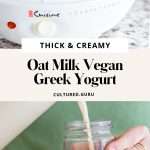
PrintThick and Creamy Oat Milk Greek Yogurt
Learn how to make vegan yogurt with oat milk and vegan yogurt starter. This creamy and thick oat milk yogurt recipe is so easy! You can enjoy oat yogurt with fruit, honey, and granola, or try it savory with miso butter jammy eggs and toast.
- Prep: 30 minutes
- Cook: 10 minutes
- Total: 30 minutes
Ingredients
- 950 mL oat milk (no thickeners)
- 350 mL 100% Full Fat Coconut Cream (no thickeners)
- 5 grams agar agar*
- 50 grams of store-bought vegan yogurt with live active cultures (or a packet of yogurt starter culture)
- 50 mL Lemon Juice
- 50 mL Maple Syrup
Instructions
- Pour the oat milk into a saucepan and heat over medium heat. Stir continuously.
- While your milk is heating, whisk together the lemon juice and maple syrup.
- Stir the simmering milk and slowly sprinkle in the agar. The agar should dissolve completely and fully incorporate into the liquid mixture. Keep stirring for about 5 minutes while simmering.
- Allow the milk mixture to slightly cool. The temperature should cool down to about 110° F.
- Add in the full-fat coconut cream, the lemon juice, the maple syrup, the starter cultures, and the milk mixture to a blender. Blend on medium low until smooth, about 2 minutes.
- Next, you are ready to incubate! Dispense the milk mixture into the clean jars for your yogurt maker. Be sure the lids are off, turn it on and let it incubate for 12 hours. (My yogurt maker has one set temperature of 107°F)
- When your yogurt is done incubating, you can give each jar a good stir. Then put lids on and place them in the refrigerator. Once cooled, add in some fruit and enjoy!
Notes
- Using oat milk and coconut cream that have added thickeners, like guar gum, gellan gum, locust bean gum, etc. can result in a consistency that is too thick, like jelly. Homemade oat milk and canned coconut cream without any thickeners work best in this recipe. You can try leaving out the agar if you are using coconut cream and plant-based milk that contain added thickeners.
- Most agar package directions recommend agar measurements that result in a fully solidified firm gel. To make smooth yogurt you have to use less than the package suggests. You should only use 3-5 grams of agar. You must weigh the agar with a kitchen scale to ensure you do not use too much.
- This recipe has been re-tested, updated and improved as of November 2021






Greetings! I tried my first vegan yogurt last night in the recommended Euro Cuisine. I used shelf-stable boxed unsweetened almond milk with no additives, so I did not heat it (per your footnote). I used arrowroot in place of agar-agar since I didn’t have any, and I left out the coconut milk. 13 hours later the content of my jars have separated. The bottom 60% is a murky liquid and the top looks like yogurt. What do you think went wrong? TIA
hey there! You cannot substitute agar for arrowroot powder. It does not function the same as a thickening agent. Coconut cream, along with agar, is essential to the recipe resulting in thick and creamy yogurt.
Kaitlynn,
I appreciate your reply very much! Ah! Must have agar – got it! New to all the plant based ingredients. I will get some and report back. In an earlier question, you said the coconut cream could be left out. I’m working to reduce my cholesteral so wanted to avoid it. Thoughts?
Thanks again – so happy I found you! Blessings…
yes, leaving the coconut cream out is fine. Both the agar and coconut cream contribute to a thick and creamy texture, so leaving both out was your issue. As long as you use the agar (and make sure you dissolve it in boiling water) it will come out with an acceptable texture.
Love your responsiveness. Thanks again. I will persevere!
Are you using agar powder or agar flakes? Thank you!
I use a powder, but either will work because you have to dissolve it all in boiling water first.
Thank you kindly for sharing not only a proven recipe, but the chemistry dynamics and purpose of each ingredient i.e. Homemade Yogurt 101. I just removed my jars of beautiful yogurt from my Instant Pot and I had a serving with fresh strawberries 🍓 blueberries 🫐 & my homemade granola topped with walnut halves. So good! My next batch I will cut the agar powder ( made by Now) to one tablespoon as the yogurt solidified unless you could provide your expert advice. However, it’s the best yet for me after making numerous other recipes on the Web. Lastly, please let me know the ideal temperature to add the starter as my milk mixture was 135 degrees after it simmered and after adding the coconut cream. And I believe the temperature should be between 105 and 116 degrees so as not to destroy the probiotics. BTW, I used yogurt from my last batch as a starter.
I’m so glad you enjoyed the recipe! Yes, the mixture should cool to about 110° F before adding in the starter cultures. I added the ideal temperature to the recipe instructions. Thank you for your feedback!
I eill make your recipe as is, but I have two questions: 1) What brand of agar agar powder are you using? This would help as they seem to have different gelling power, I am new at this, don’t know much about it… mine is Landor Trading Co (average gel strenght 700 mg/2cm+. They say: “agar can be made into gel by adding 15 grams of agar powder to 1 liter of cold water, stir and bring the water to boil either in a microwave or stovetop. Once it has boiled, stir again and allow to cool and become a gel.” So would I follow exactly your recipe or do I need to mix the agar powder, boil it and then add the other ingredients (maple syrup, etc.), then add it to the milk in my Vitamix?
2) Can I put the mixture into a big glass container (the one of my Yogourmet yogourt maker) instead of putting it in small jars (that I dont have)? Thank you so much! Your recipe seems to be the best I have seen so far, and I jave been searching a lot!
Hi Kaitlyn
I enjoy your website!
I just made homemade coconut yogurt with Agar Agar as a thickner and Yogourmet non-dairy yogurt starter. The instructions said I needed to incubate 6-8 hrs. I incubated it for 8 hrs in my Euro-cuisine appliance. The yogurt did set and tasted fine.
However, as I search the internet, I’m reading that coconut yogurt should incubate for at least 12 hrs.
Will I get sick from eating this yogurt that has not incubated enough?
Also can you recommend any store-bought nut milks that I can use to try to make almond milk or cashew milk yogourt?
Thank you,
Terry
No, a short incubation time shouldn’t make you sick. I don’t drink much almond or cashew milk, so I can’t personally recommend a brand, but I’ve heard good things about the brand Elmhurst and they make a variety of nut milk.
Can I use store bought vegan yogurt as a starter
Yes! I do that all the time.
Hi Kaitlynn,
Could I substitute the oat milk for coconut milk? I’m trying to find a gluten free milk option.
Thank you
Beth
yes! as long as you keep all the other ingredients the same
is there any way you can give a rough idea of protein content as this is high in milk based Greek yoghurt as vegans this element of our diet is very important. thanks
I’m sorry, I do not provide nutrition facts for my recipes.
Much as I appreciate your post I’m surprised that a microbiologist cant give a rough idea of protein – if you cannot can you tell me how to work it out form the ingredients list myself? thanks
I never said that I can’t. I said “I do not”… very different things. Google it and figure it out yourself. I am not obligated to teach you on demand.
There are tons of nutritional content calculators online!
Like another commenter, my agar turned into a big blob when I added hot water. It took a lot of work with my handheld blender to incorporate the blob. Next time, I think I’ll add the agar slowly to the hot soy milk while blending to see if it incorporates better. Also, I don’t have a yogurt maker, so I’ve been using a therapeutic hot pad under my bowl and that seems to work just as well, so long as I wrap the whole thing in a towel to prevent heat loss.
Hi Kaitlynn, Is it possible to make a plant based yoghurt with no coconut?
yep! Since this recipe calls for agar, you can probably leave out the coconut cream with good results. I haven’t tried this however, so if you try it let me know how it turns out!
Can I use a old yogurt insulated tub to incubate the yogurt?
I don’t see why not. You still need to make sure the temperature is about 40° C during incubation.
Is the lemon juice just for flavor or is it necessary for some process to make the yogurt come out? In other words, if I leave it out, will the recipe fail?
The lemon juice is for optimal yogurt flavor and for preservation, it makes the yogurt last longer. You can try it without, but I’m not sure if the final flavor will be very good without the lemon juice.
I’m getting ready to try your delicious sounding recipe! One question: I’ve made cows milk yogurt for years in a sous vide in sealed qt glass jars with great success.
You state this recipe should be made in open jars. Is this because of gas production during incubation and trying to prevent explosion, or to allow the mixture to dry out a bit during the process? Thank you for your input and thorough directions. I can’t wait to try it!
Someone else just asked about sous vide incubation too! You can use the same incubation method with this recipe. The lids off in the yogurt maker is just to prevent condensation in the individual jars. Enjoy!
Wow, I appreciate all the answers you’ve given to everyone! I searched to make sure this hadn’t been answered already but didn’t find it. Is it OK if the probiotic has V12 added to it? Also, I saw that you said pre-sweetened yogurt was OK. I kept reading that it had to be just soy, nothing else. Is this a myth? Thanks in advance!
Oops, I meant to ask about pre-sweetened soymilk, not pre-sweetened yogurt.
Yes, pre-sweetened milk will work fine! Are you using a probiotic capsule with vitamin B12 added to it as a starter culture? I think that should be okay, but I’ve never tried it.
I was given an old yogurt maker from the 70s and I want to try it. I have cashew milk and almond milk an one store bought soy yogurt. I live in Costa Rica and I have no idea where to get agar agar. Any idea how best to use what I have?
You must use a thickener for this recipe. If you can get gelatin where you are, that’s a good substitue for agar, but the amount you need to use will be different.
I have been making milk based yogurt in a sous vide machine 109 deg for 6-12 hrs depending on tartness. (I’d like to switch to a vegan option ) Obviously the lids are on the jars in the water. You mention the lids should to be off in the yogurt maker. What if any changes should I think of if I want to sous vide for the incubation part or is it not even doable. Thanks.
Having the lids off in the yogurt maker just helps condensation not develop in the jars. You can do the sous vide with the lids on!
Hi! Great recipe! I am currently experimenting with yogurt made from homemade soymilk. Is the lemon juice added for fermentation, flavor, or texture? Would adding strained whey from a previous batch achieve the same effects? I’ve heard of some “conditioning” their milk before fermentation by adding an acid and wondering if that’s the idea
Thanks! Lemon juice is added for all of the above reasons. Yes, you can add whey from a previous batch 🙂
Hi! I was just wondering if I could use gelatin instead of agar agar. If yes, how much? That’s so much!
you can, but I do not know how much, as I’ve never tried it myself. You can try an even substitution (5 grams) but I can’t tell you how it will come out.
If you try it let us know how it goes!
Hello,
Thank you for this amazing recipe. The first time I made it, I used soy milk and I had great results. The second time, I was making it for someone with a thyroid disease who cannot have soy. I used oat and almond milk and the yogurt was thin and I did not like the taste. Is there a brand of oat milk you prefer? Or another combination of milk you would recommend that doesn’t include soy?
For someone who cannot have soy, I sugest using 100% full fat coconut cream (I like the cans of coconut cream from trader joes and Thrive market). You can leave out the agar and water if you use 100% coconut cream for the base.
Thank you for your reply! So don’t use any other milk, just 4 quarts of coconut cream? And then an additional can of coconut cream on top?
oh no, not four quarts, just one. You just need 32 ounces of coconut cream, 2 tablespoons yogurt, 2 tablespoons maple syrup, and 3 tablespoons lemon juice.
Aaahhh, my mistake. Will definitely try that, thank you so much!
So I tried all coconut milk and found it was too fatty. Then I did 18 oz. cashew milk, one can of coconut milk and one can of coconut cream. I omitted the water, but I stuck with 1 tablespoon agar. My yogurt sat in the fridge after culturing for 12 hours and came out solid like jello so I blended it in a vita mixer. It blended nicely to a Greek like consistency, and tasted great but then after it sat in the fridge, it became grainy, almost as if the coconut fat turned into tiny solid granules. It tastes great and when you eat it, and the grain dissolves in my mouth. Do you have any ideas how to prevent it from getting grainy? Once I figure that out, this milk combination will be a winner taste wise.
I need to do some recipe tests and rewrite this recipe. It’s just not reliable when you start to change ingredients. Sounds like the grainy texture is from the agar. Honestly, I think you would do better with this dairy-free yogurt recipe of mine. It’s my favorite one and far superior in flavor and texture. https://cultured.guru/blog/dairy-free-coconut-cashew-yogurt
Thanks for the great recipe! Just want to know if i can replace maple syrup to white sugar ,lemon juice to apple cider vinegar instead? thanks !
I’ve never tried, but I think those substitutions should work out!
I loved this recipe! So much tastier than store-bought vegan yogurt. Is it OK to double the recipe? We eat a lot of yogurt in this house and could eat a double-batch in two weeks for sure 🙂
Also, can you clarify the purpose of the glass jars? I made this the first time in a Ninja Foodi (like an Instant Pot), using the yogurt setting. I didn’t use the glass jars. I don’t know if it is it OK to use glass jars in an instant pot so would like to know their purpose.
The glass jars are just for individual servings and are generally used with most yogurt makers. I also make yogurt in my instant pot, just in the metal insert, and it works great.
Oh I’m so happy you love the recipe!!! Yes, I think you can double it. Just press the 2x button on the recipe card.