


Oatmilk Yogurt
Making vegan yogurt at home doesn’t have to be complicated, but the process is very different from traditional dairy yogurt.
Due to the nature of plant-based milk and the microbiology of yogurt making, plant-based milk will not thicken into a yogurt-like substance just by adding a culture. Cultured full-fat coconut cream will be a semi-solid mass at room temperature because it’s’ full of saturated fats… but dairy-free milk, like oat milk, will not.
Vegan Greek Yogurt
Various probiotic bacteria play essential roles in the production of yogurt. Most often, species of Lactobacillus, Bifidobacterium, and Streptococcus are the microbes found in multiple types of yogurt.
Specific types of yogurt, such as Greek and Belgian, are distinguished by the species of bacteria used to culture milk into yogurt.
In animal-sourced milk, the bacteria can use lactose for energy. When microbes use up lactose, they produce lactic acid.
Lactic acid builds up in the milk causing the coagulation of milk proteins. Once proteins coagulate, the milk transforms into a semi-solid mass with a drastic change in taste.

Vegan Yogurt Recipe
Lactic acid fermentation is not the same in dairy-free/vegan yogurt made with oat milk. Plant-sourced milk does not contain lactose.
Instead, bacteria utilize other sugars and proteins for metabolism and reproduction. The bacteria still produce some acid in dairy-free milk, so the flavor is slightly tart. However, plant-based milk does not have the same proteins that coagulate in the presence of an acid as in animal-sourced milk.
We have to add a thickener to create dairy-free yogurts that are thick and creamy. Our favorite thickener to use when making dairy-free yogurt is Agar agar. Agar is vegan and made from a type of sea vegetable.

Oat Milk Yogurt
The plant-sourced milk that works the best with vegan starter cultures is soy milk. However, other plant-based milk can work.
For this oat milk yogurt recipe, we used a mix of coconut cream and homemade oat milk, and it’s delicious! Feel free to use or blend any plant-based milk for this recipe. Just verify that the milk and coconut cream you are using does not contain any thickening agents.
Vegan Yogurt Starter
You might be wondering how to make vegan yogurt with starter culture. You have two options when culturing yogurt: Use a starter culture or already made vegan yogurt.
We like the second option because already-made dairy-free yogurt is easily accessible from stores like Whole Foods.
So is yogurt culture vegan? It depends on where you get it. If you prefer to use a starter culture, you can order a high-quality vegan starter culture online, like this one.

High Protein Dairy Free Yogurt
To make this a high-protein yogurt, without concern about it being vegan, you can add collagen powder to the recipe. You can blend in a scoop of collagen protein when you blend in the starter cultures.
Oat milk yogurt recipe
Here is a list of all the supplies and starter cultures you need to make this recipe:
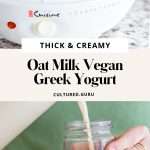
PrintThick and Creamy Oat Milk Greek Yogurt
Learn how to make vegan yogurt with oat milk and vegan yogurt starter. This creamy and thick oat milk yogurt recipe is so easy! You can enjoy oat yogurt with fruit, honey, and granola, or try it savory with miso butter jammy eggs and toast.
- Prep: 30 minutes
- Cook: 10 minutes
- Total: 30 minutes
Ingredients
- 950 mL oat milk (no thickeners)
- 350 mL 100% Full Fat Coconut Cream (no thickeners)
- 5 grams agar agar*
- 50 grams of store-bought vegan yogurt with live active cultures (or a packet of yogurt starter culture)
- 50 mL Lemon Juice
- 50 mL Maple Syrup
Instructions
- Pour the oat milk into a saucepan and heat over medium heat. Stir continuously.
- While your milk is heating, whisk together the lemon juice and maple syrup.
- Stir the simmering milk and slowly sprinkle in the agar. The agar should dissolve completely and fully incorporate into the liquid mixture. Keep stirring for about 5 minutes while simmering.
- Allow the milk mixture to slightly cool. The temperature should cool down to about 110° F.
- Add in the full-fat coconut cream, the lemon juice, the maple syrup, the starter cultures, and the milk mixture to a blender. Blend on medium low until smooth, about 2 minutes.
- Next, you are ready to incubate! Dispense the milk mixture into the clean jars for your yogurt maker. Be sure the lids are off, turn it on and let it incubate for 12 hours. (My yogurt maker has one set temperature of 107°F)
- When your yogurt is done incubating, you can give each jar a good stir. Then put lids on and place them in the refrigerator. Once cooled, add in some fruit and enjoy!
Notes
- Using oat milk and coconut cream that have added thickeners, like guar gum, gellan gum, locust bean gum, etc. can result in a consistency that is too thick, like jelly. Homemade oat milk and canned coconut cream without any thickeners work best in this recipe. You can try leaving out the agar if you are using coconut cream and plant-based milk that contain added thickeners.
- Most agar package directions recommend agar measurements that result in a fully solidified firm gel. To make smooth yogurt you have to use less than the package suggests. You should only use 3-5 grams of agar. You must weigh the agar with a kitchen scale to ensure you do not use too much.
- This recipe has been re-tested, updated and improved as of November 2021






Hello Kaitlynn how long Will last my oat milk yogurt at fridge temperature?? Thanks for the recipe!!
It should last about 2 weeks!
I need help! Second try at oat milk yogurt with still awful results.
I used a probiotic vegan yogurt additive and tapioca starch, which was noted elsewhere as a good swap out for agar-agar.
,
First, is the cream of coconut the canned kind sold for drink mixers? I can’t seem to find another, and that seemed super sweet.
Second, is the maple syrup needed? I don’t like sweet yogurts at all. If the sugars are needed for the pro-biotic bacterias to activate, would the sugared cream of coconut be sufficient?
Finally, I am processing in a crock pot, which works great for dairy yogurt. Is this my big problem? Is non- dairy more finicky?
Half of my intent is based on my diet transitions. I sleep better with less dairy, and my BP needs work as does my weight. The other is the planet – I (we all) need to eliminate plastics, and I cannot find quart containers of yogurts of any kind that are not using plastic. I so much appreciate any guidance you might have for me on successful homemade oat milk yogurts.
I’ve never used tapioca starch as a substitute for agar, and I do not recommend it.
This recipe calls for full fat coconut cream and the only ingredient in coconut cream is coconut and it is not sweet. It’s sold in a can, usually in grocery stores near seaweed and soy sauce. Please use the ingredients as listed in this recipe for the best results.
A crockpot is not advised, as the temperature is too hot. The temperature needs to be 40° C for proper yogurt incubation.
Thank you.
Yes, the coconut cream was the wrong item. I am certain that was an issue.
The crockpot is preheated, turned off, then wrapped in wool with jars inside. Works great with dairy yogurts. I’m giving it one more try with oat milk, and then will see if I need to get a yogurt maker. We live small, and I have little room for more appliances. Worth a shot!
Can this be made without a yogurt incubator (using a ready made vegan yogurt as the culture) ?
It works best with a yogurt maker, but you can try incubating at a warm room temperature.
Would probiotics work as a starter for the first batch? I plan on making my own oat milk and soy milk and combine them for vegan yogurt. My first batch of soy yogurt worked well but had a rather bitter for taste.
That should read bitter after taste.
Probiotic capsules may work. But use with caution. Some Probiotic capsules contain microbes that don’t result in the best yogurt.
I would love to see if you can adapt this recipe for a slow cooker as there are a lot of regular yogurt recipes that are done completely in the slow cooker.
Thank you for the suggestion! I might be able to include directions for this one day, but I do not currently own a slow cooker to test this incubation method.
I use the yogurt setting on my instant pot, works terrific. Thank you for your great recipes, as a chemist, I really appreciate the depth of your posts.
So great to know! Thank you! I get a lot of questions about making yogurt in an instant pot.
Is the slow cook button on instant pot the same as yogurt mine does not have a yogurt button but does have a slow cook.
It is not the same thing. You might be able to use it, but only if yours lets you set the precise temperature between 104 and 107 F.
Hello, I came by your post because I just made my first batch of vegan yogurt and it was great but not as thick as I would like. Can’t wait to try your recipe. What is the lemon juice for?
The lemon juice adds a balanced acidic flavor since the yogurt microbes do not metabolize plant-based milk the same way they metabolize animal-sourced milk.
Hi! I am wondering if I can use part of the home made cultured yogurt to start a next one. My question is: would the bacteria be still alive?
Thank you for your work! 🙂
hey there,
Yes, you can use yogurt to culture the next batch. In the recipe, I have that you can use two tablespoons of already made yogurt or a starter culture. The bacteria in the yogurt should still be alive, as long as the yogurt isn’t too old.
Hello! Do you think it would be possible to use a couple of capsules of commercial probiotic in place of the starter culture? I take a specific single strain of probiotics and it’s expensive, so I’m looking for a way to grow more of them on my own. Any thoughts?
I think you can give it a try! But I can’t guarantee how it will turn out, because it depends on what bacterial strains are in the probiotic and if the probiotic also contains any beneficial fungi. Sometimes the microbial species included in a probiotic supplement are not ideal for yogurt flavor and quality.
I’ve tried a bunch of recipes but nothing like this. I can’t wait to try it. I want to do the gut health recipe that goes for 36hrs at 99F and its probiotics in it. I’m assuming all of this would be fine to go for longer.
Can this be made without the coconut the coconut cream? I am allergic to coconut, is there any substitute that would work?
You can just leave it out and the yogurt should come out just fine. The coconut cream just adds a little more creaminess to the yogurt.
Hi. Just made my first batch with IP and it’s a dream. Question: can you use the same home made yogurt as starter for your next batch? Thx!
You sure can!
How long in the instant pot??
it should incubate for 12 hours
I’m not sure why but I’ve made the recipe twice and have obtained a thick gelatinous result. I only used the 5 g of Agar and followed instructions. Used oat milk and the canned coconut cream. Used the recommended starter cultures too.
I’m hesitant to try again it I’m really wanting to make my own yoghurt. Any thoughts for me?
sounds like you might be using oat milk and coconut cream that have added thickeners, like guar gum etc. So there’s just too much thicker in it. You can try leaving out the agar if you are using coconut cream and oat milk that contain added thickeners
It’s possible have a metric recipe? Thanks
sure! I just added the metric ingredient measurements in the notes on the recipe. 🙂
Could you check the lemon juice and maple syrup metric volumes? Is the amount of lemon juice supposed to be the same as the boiling water (60 mL)?
BIG oooops! there was a major typo for the maple syrup in metric. I just fixed it.
It’s
Boiling water: 60 mL
Lemon Juice: 50 mL
Maple Syrup: 35 mL
I used a cashew yogurt starter and Oat Milk.
When the 12 hrs were over I was in bed.
The yogurt was at room temperature for some time before I got back to it.
It is not jelled and is quite seperated on top, and loosely formed.
It smells nice and tangy, just looks bad.
Can it be saved?
Are you saying it was separated and loosely formed before or after refrigeration? It needs to be refrigerated to finish setting.
Can I use a sourdough starter as my oat milk yogurt starter?
No, Definitely not. You will not make yogurt if you do this, and you can make yourself sick eating uncooked sourdough starter. For this recipe, you can use a yogurt starter culture or already made vegan yogurt as the recipe states.
Hi!! I absolutely love this recipe and was wondering if you have tried pectin in place of agar? I was told that it could help with an even thicker yogurt.
Thank you!!
I haven’t personally tried this, but I’m sure it would work fine!
Hello Kaitlynn,
What would happen if I don’t put maple syrup in the recipe ? Thank you
It should come out fine, maple syrup just does a lot for the flavor in my opinion.
I know the milk proteins wd still be absent, but would adding lactic acid make a thicker yogurt, or just produce a lot of whey with curds?
Adding lactic acid straight to plant-based milk wouldn’t do much but give it a sour flavor. It’s possible that adding the precursor sugar, lactose, would make the process more similar to dairy yogurt. However, even with that addition, dairy-free milk will not coagulate like dairy milk.
Hello! This looks wonderful, but my last yogurt trial using agar agar produced a very grainy, poor textured yogurt, was that likely because the agar didn’t dissolve? I don’t want to make the same mistake again!
Yes! That’s probably what happened. Agar has to be mixed in a liquid that’s hot enough to dissolve it fully.
I tried this recipe and it did not turn out as expected. This was my first time using agar agar and it came from a bulk bin so there were no directions. When I added the 2T to the boiling water mixture it immediately turned into a solid blob. When I added the blob to the pot of heated oat milk it didn’t incorporate like I thought but stayed solid aside from me forcing it apart. I put it all into the blender and blended the heck out of it, which worked out well. The yogurt incubated for roughly 15 hours bc I made the yogurt at 3pm. After refrigerating, the yogurt is still somewhat thin with an odd taste. What did I do wrong? Any advice on using the agar? Did i incubate the yogurt too long? Thanks!
Have you ever made your own vegan yogurt? It does not taste like dairy yogurt. The taste predominately comes from the type of milk you choose to use. The consistency is due to the amount of agar, you may need to use a bit more agar for a thicker yogurt. For a mild flavor, I suggest using soy milk instead of oat milk.
If I only have sweetened soy milk on hand can I just omit the maple syrup? Thanks!
absolutely! That should work fine.
I’ve been making yogurt for years and my experiments with plant based yogurt has left me with pretty mediocre results. This recipe is excellent and will be a staple for me. Thank you!
I’m so happy to hear that you enjoyed the recipe!
It seems from some of the responses on other posts, substituting different vegan milk options is okay. But I haven’t seen anyone ask specifically about cashew milk. It has the lowest fat and carb count. Is cashew milk a viable alternative to soy or oat milk? Thanks in advance.
You should be fine using cashew milk, as long as you keep everything else the same. The trickiest part of this recipe is to get the amount of agar right for thick and creamy yogurt 🙂
Do we need to use lemon and mapple syrup? Can we just make it without?
Also, can we vary the quantities and this recipe is for families rathern than 1 or 2 people:)
Thanks
I think the lemon and the maple syrup balance out the flavor really well, but yes you can leave them out. You can vary the quantity using the 1x, 2x, and 3x buttons on the recipe card.
Hi KAitlynn, the first time making vegan yogurt it worked great, but the more batches I make using my homemade yogurt as a starter the less acidic it tastes. The first round was great, the second one was ok and the third one is not edible (in my opinion the taste is off). The yogurt did set, but it’s also getting a bit more liquid every time. I’ve never used lemon juice since I usually like plain yogurt. Do you think I can salvage the last batch if I just add a bit of lemon juice to the already set yogurt? The starters of homemade yogurt that I used have been about 7-9 days old, do you think the bacteria died during that time and that’s why my yogurt tastes different now?
Thanks for the recipe! I’m using Ripple (pea milk) by the way. It has a higher protein content than most plant-based milks so I haven’t had the need to add agar to it and the texture of the yogurt is similar to Greek yogurt.
Using previous batches of vegan yogurt to innoculate the next batch can be difficult, and much more difficult than using this method with dairy milk. The microbial population can shift or change throughout storage and batches. It may be best to use fresh starter culture every third batch.
I’ll have to give that type of milk a try!
Thanks for the answer! I thought it would be just like dairy yogurt and that I had found the key to infinite vegan yogurt, alas!
You can buy an heirloom yogurt starter that you can use indefinitely. Cultures for health makes a vegan yogurt starter. The grocery store yogurts are made with a blend of a few bacteria that produce great results at first, but one strain quickly dominates the rest. An heirloom is balanced and will maintain that balance indefinitely.
Not necessarily true when using plant-based milk. Even heirloom culture populations can suffer and/or shift after a few batches without lactose to metabolize.
Can you give nutritional content please? Or did I miss it in the post? Thanks!
Hi there,
I currently do not provide nutrition facts for our recipes. It may be something we add to our blogs in the future.
Hi, this might be completely off base but I was wondering if I could use Biome Beauty as the culture, and if so how much of it I should use? Also, can I use a proofing drawer instead of a yogurt maker? What temperature are we aiming for during the incubation period?
No, I wouldn’t use Biome Beauty to make yogurt. It’s best to stick with a yogurt starter culture or already-made yogurt. You can use a proofing drawer. The ideal temperature is 40° C.
I am thrilled to find this recipe. Others seemed really fiddly but this one is very straightforward with ingredients I love. I’ve been making mine with organic JOI almond milk base, which just includes almonds. It makes more than my incubator can hold so I’ve usually just set the overflow near our woodstove, which has been going all winter. But it’s 60 degrees today so I’m on the hunt for ways I can incubate without the machine. Also today I’m trying it using some from my previous batch as a starter. I hope it works!
Hi! I recently found the Culina brand of vegan yogurt and absolutely love it, but it is almost $5 for each small jar. I want to try your recipe but my question is….can I use coconut milk and coconut cream instead of oak milk and coconut cream? The ingredients in the Culina yogurt are organic hand chucked coconut, water, agar, probiotic. I like the taste of coconut over oat milk so hoping this would work. Thank you!
Yes, absolutely. Using coconut milk and coconut cream will work great!