


Choosing Quality Cucumbers for Fermentation
I suggest using one of three types of cucumbers when making these dill and horseradish pickles. First, English cucumbers, the long cucumbers normally sold tightly wrapped in plastic, work well. The second is pickling cukes; these are the shorter, bumpy, lighter green cucumbers. Third is the Persian cucumber (my favorite), also known as teeny tiny or cocktail cucumbers.
Do not use slicing cucumbers for fermentation. These are very smooth, dark green cucumbers. They’re usually fat and long. Most slicing cucumbers will turn into a soggy mess through the fermentation process. Slicing cucumbers are also normally wax-coated, which disrupts the fermentation process.
Here’s my checklist for choosing good cucumbers:
- Density: The cucumber should feel heavy, like it is hydrated and has turgor pressure. It should not feel hollow, like yellow squash, if you tap your finger against it.
- Check for surface mold: Look for indentations and soft spots in the cucumbers. You do not want to buy a squishy cucumber. Cucumbers near molding will have dark, small, circular indentations or black “pocks” on the surface.
- Small is Better: The bigger the diameter of the cucumber, the soggier your pickles will be. For English cucumbers, look for one with a smaller diameter. If you are buying pickling cucumbers, go for the smaller, daintier ones. If you can find cocktail cucumbers, they will work fantastically.
- Color: Pickling cucumbers should be predominantly green with streaks of yellowish-green. English cucumbers should be a solid medium green color.


Crisp, Fermented Horseradish Pickles
How you slice cucumbers impacts how the horseradish pickles will hold up during fermentation. You should always remove the ends of cucumbers and not include the ends in the fermentation. The blossom end of cucumbers contains enzymes that can soften the cucumbers.
t’s also vital to remove the seeds of large (I’m just going to say it, girthy) cucumbers. Mature, overgrown cucumbers have broad seed cavities with lots of enzymes, high water content, and weak cell structures. When exposed to salt, the watery centers lack the structural integrity needed to stay firm and physically break down, leaving the pickle hollow or soft from the inside out.
So if you have a bigger, mature cuke, you need to scoop out those seeds. Mature cucumbers with bigger seed cavities are probably the number one reason our readers end up with soggy pickles.
There are two slicing techniques I recommend when fermenting any sort of pickles. For pickle chips, a ripple-cut pickle holds up better than a straight-sliced pickle. You can get a cheap and simple ripple cutter by clicking here. I also suggest fermenting pickle spears or halves, which tend to hold up even better than pickle chip slices. Spears and halves can be cut with a regular knife.


Preventing Sogginess in Fermented Pickles
To help prevent sogginess, start with cold cucumbers and a 3.5% total salt concentration. The most important thing you can do to keep your fermented pickles crisp is to use at least 3.5% total salt. That’s what the recipe calls for, so just follow it as written.
You can add bay leaves, sencha green tea, and grape leaves for tannins. You can also try adding calcium chloride salt to pickles, which is very effective at keeping things crunchy. (Some sources of calcium chloride are natural from limestone… and some are chemically produced. I suggest researching this salt and deciding for yourself if you’d like it in your food).
Don’t forget, as mentioned above, how you slice your cucumber matters. Stick to ripple cuts or spears/halves for the best results.
If you still end up with pickles that just aren’t as crisp as you’d like, use them to make delicious Fermented Pickle de Gallo!
What Type of Horseradish to Use
I have to be honest, I’ve never bought, grown, or used fresh horseradish before. So I can’t really recommend it in this recipe. I went for prepared horseradish, Bubbies brand. And it worked wonderfully. I also use prepared horseradish to make steak horseradish sauce with sour cream, so I’m not going to waste it.
If you decide to use fresh horseradish in this recipe and want to share your experience, let us know how it goes in the comments!

What Should My Horseradish Pickles Smell and Look Like?
As always, I tracked these pickles through the whole fermentation process, so I can tell you all about the sensory cues to watch for as they ferment! This timeline is for pickles fermented at 72-78 degrees F. The process will be slower in colder conditions and faster in warmer conditions, but will follow the same pattern.
24 – 72 hours: All contents in the jar should be submerged beneath the brine. The brine will be pretty clear at first, and will start to get a bit murky. You’ll see little bubbles forming in between the pickle slices. There won’t be a ton of bubbles until about day 4, though. (This is stage one of fermentation, and there’s not much going on that you can see)
72 hours – 7 days: After 72 hours, you should start to see lots of bubbles. You need to burp the jar if you are using a rust-proof mason jar lid (as I recommend). Cucumbers in this stage should change color from vibrant green to pale olive. You will also notice the brine becomes very cloudy. Leuconostoc bacteria begin to thrive, producing lots of carbon dioxide and acetic acid. You can open the jar whenever to ensure everything is submerged and the lid stays clean. If anything is floating to the surface, scoop it out with a clean spoon. If the lid looks dirty at all, wash it with hot, soapy water, then place it back on the jar.
7 – 12 days: Bubbles in the brine will decrease as the ferment leaves stage two and enters stage three of fermentation. The brine will be quite cloudy and start to develop a pleasantly sour smell. You’ll probably start to see sediment at the bottom of the jar, and the bubbles will stop completely. Lactobacillus species are most abundant.
12 – 14 days: Lactobacillus makes up the majority or all of the microbial population now. They produce copious amounts of lactic acid, making the pickles smell even more pleasantly sour. At this time, you can smell, taste, and refrigerate! The pickles should have a pH of 4 or below. They are now super probiotic and well preserved.
What if my horseradish pickles are too salty?
If these fermented pickles are too salty for your taste buds, it’s an easy fix! Pour off half the brine into an empty jar and top off the pickles with apple cider vinegar. Shake to combine. This will dilute the saltiness and add a lovely vinegar flavor. And don’t worry, vinegar does not kill the acid-tolerant probiotic microbes in the pickles. Be sure to save the brine to make my probiotic pickled garlic or probiotic pickled onions.


Things You May Need:


Fermented Dill and Horseradish Pickles
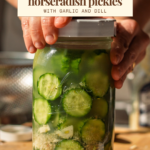
These are possibly the best pickles I’ve ever fermented. Maybe I’m biased because I love horseradish. If you do too you must try these fermented horseradish pickles!
- Prep: 20 minutes
- ferment: 2 weeks
Ingredients
- 460 grams cucumbers*
- 320 grams water
- 28 grams sea salt
- 1 fresh dill sprig
- 2 tablespoons prepared horseradish
- 1 tablespoon minced fresh garlic
Instructions
- Please see the recipe notes before you begin.
- Wash all of your fermentation equipment (jar, weight and lid)
- Wash your cucumbers in cool water.
- Slice your cucumbers either as ripple cut chips or as spears/halves. Remove and discard the cucumber ends.
- Place your kitchen scale on the counter. Turn it on and set it to weigh in grams.
- Weigh out the designated amounts of all your ingredients.
- Add everything to the mason jar. (It helps if you put anything cut small, like garlic and horseradish, below the cucumbers to keep them from floating)
- Place the lid on the jar, and secure it. Shake the jar vigorously for 2 minutes to dissolve all the salt.
- Remove the lid. Place your clean fermentation weight in the jar, making sure to submerge the cucumber pieces and weight fully in the liquid.
- Secure the lid to the jar (you don’t need to tighten it too much; just close it).
- Let the horseradish pickles ferment for 14 days at room temperature. Set the jar in a glass dish to catch any spills.
- If you tighten the lid a lot, you should burp the jar daily when it is bubbling. It also helps to open up the jar daily to rinse the lid clean and re-submerge or scoop out any floating bits.
- After 2 weeks, remove the fermentation weight and smell and taste test. Your horseradish pickles should smell pleasantly sour and taste tart and salty. (if it’s warmer in your kitchen you can taste test around 10 days).
- Too salty for you? Pour off half the brine into an empty jar and top off the pickles with apple cider vinegar! Shake to combine. Save the brine to make my probiotic pickled garlic or probiotic pickled onions.
- Store in the fridge. Please leave a five-star rating below if you love this pickle recipe!
Notes
- The timeline is adjustable based on temperature. Fermentation is faster at warm temperatures. You can taste test at 10 days and see how you like them.
- This recipe at 1x is for a 32- ounce jar.
- Pickling, Persian, or cocktail cucumbers work best. Cucumber recommendations are in the first paragraph of this blog post.
- If your cucumbers have large seed cavities, scoop out the seeds and cut into spears.







Mizz Kaitlynn,
Please pardon this question from one who has been out of high school chemistry for more than a half-century, but what is the calculation for total salt concentration? I had thought that it was weight-of-salt divided by weight-of-water, but that doesn’t seem to work here.
Thanks,
Joe
approximate total salt concentration = grams of salt ÷ (grams of cucumbers + grams of water).
You have to include the weight of the cucumbers since they are 98% water.
I opted for the vinegar wash at the end of this recipe and it was SO good. Would have never thought to add horseradish to my pickling liquid.
This was my first time fermenting pickles! Yum! Such a fun food experiment. I love the spicy twist with horseradish.
I made these recently, they are absolutely delicious. Crisp, tangy and the addition of horseradish is a winner.
100% approved at home.
Need to never run out of it.
Great combo with the horseradish. I wouldn’t have thought of it.
Thanks for sharing this free recipe.
Thank you for leaving another review! I appreciate the feedback and super glad to hear you love the recipe 🙂
Could you suggest how to preserve this after fermentation, so I can have these all year long?
I haven’t fermented then canned for shelf stable pickles yet, but Ball Canning has some resources in their Ball Blue Book Guide to Preserving on how to do that.
So so good! We have almost eaten the whole jar in a week.
So excited to make these, this is the kind of pickle I grew up with!
I’m having trouble getting the liquid to fully cover the pickles. I did one 32oz version and one 2x and both times I’ve got a good 2 inches of pickles sticking out. Do I just top up with water or make more brine and top up with that?
you just shove them down in the brine and then place your fermentation weight. They’ll release some more liquid within a couple hours too.
I’ve made these twice now in batches where only half get the horseradish. Both times, the plain jar bubbles visibly in the first week or so of fermentation but the horseradish jar hardly bubbles at all. Any idea why that might be? The end result horseradish pickles have still changed color and definitely taste acidic/fermented and are delicious.
Are you using prepared horseradish? The early stage microbes that make the bubbles are less active with this ingredient, and it kinda fast tracts to the later stage Lactobacillus (these don’t make bubbles).
Ah yep! That makes sense, thank you
Is it a terrible idea to add water instead of vinegar if the ferment is too salty? It would be going in the fridge right away. Mine is intolerably salty and I can’t do vinegar. Also, I love horseradish, thank you for this recipe.
bad idea. Water will dilute the acidity making the pickles not safe or preserved anymore. You can use a different acidic liquid, like lemon juice.
I prepped these yesterday and am just reading the comments now. I also did not have enough liquid and made more brine to top it up. Will they be ruined now?
no, it’ll be fine. Worst thing that will happen is maybe a few soggy pickles.
Amazing. My favorite so far besides the sauerkraut recipes. Thank you for sharing.
yayyy!!! Thank you for trying these pickles and leaving a review!