

Cultured Guru Logo
Cultured Guru Logo
  • Start Here
  • RecipesWe love to create delicious recipes with gut health in mind. By using our recipes, you can easily create any dish knowing that it’s good for gut health! Our recipe blog also includes Vegan Recipes, Vegetarian Recipes, Gluten Free Recipes, and Paleo Recipes.
  • About
  • Learn
  • Shop
  • Contact
  • Start Here
  • RecipesWe love to create delicious recipes with gut health in mind. By using our recipes, you can easily create any dish knowing that it’s good for gut health! Our recipe blog also includes Vegan Recipes, Vegetarian Recipes, Gluten Free Recipes, and Paleo Recipes.
  • About
  • Learn
  • Shop
  • Contact
Peppers & Sauces

Fermented Leeks: How to Ferment Leek Tops

Are you wondering what to do with leek tops or leek greens? You should make fermented leeks! Fermented leek tops are delicious additions to many recipes.

Prep: 10 minutes
Total: 504 hours 10 minutes
Jump to Recipe Rate Recipe
Recipe Index | Ferment | Peppers & Sauces

Fermented Leeks: How to Ferment Leek Tops

Are you wondering what to do with leek tops or leek greens? You should make fermented leeks! Fermented leek tops are delicious additions to many recipes.

What to do With Leek Tops

When we cook leeks, we often have many green tops left. Leek tops are perfectly edible and acceptable for cooking, but I usually only use the bottom portion in recipes. If you’ve made it to this blog post, you’re probably in the same predicament, wondering what to do with leek tops, and I recommend making fermented leeks with the tops!

Fresh whole leeks on a white marble surface.

Fermented Leeks

I prefer to ferment the tops over the more fleshy bottom when making fermented leeks. The leek greens don’t contain as many sugars as the bottom portion, so they are more suited for Lacto-fermentation.

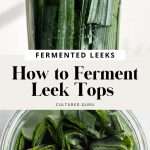
fermented leeks in a clear glass jar. The leek greens were just added to the jar, so fermentation has not started yet. The brine is clear and the leek tops are vibrant green.

You are probably wondering what you would use fermented leek tops for. There are so many options! You can mince them and add them to any cooking recipe that calls for onions. You can blend them in a food processor with pesto or chimichurri, and I like to mix them in a food processor with sour cream and horseradish to make creamy steak sauce. Get creative and enjoy the flavor!

Ingredients and Equipment to Make Fermented Leeks

Here are all the supplies and equipment you will need to make this recipe:

  • 32 ounce Wide Mouth Mason Jar
  • Fermentation Weight
  • Standard Metal Mason Jar Lid (this can rust in the presence of salt)
  • OR Rust Free Plastic Lid
  • or you can use a Weck Jar (without the gasket; only use the clips to secure the lid)
  • Scale
  • Mixing Bowl 

The ingredients are so simple:

  • Leek tops
  • Sea Salt
  • Water
vibrant colored leek greens in a jar with salter water brine, soon to start fermenting.

Fermenting Leek Greens

I recommend sticking to leek greens only. With this recipe, however, you can use the whole leek.

If you use the fleshy bottom portion of the leek, you may find that the smell is more pungent and bubbles a lot more. You may even find that it tastes effervescent with hints of alcohol.

fermented leeks in a clear glass jar. The ingredients were just added to the jar, so fermentation has not started yet. The brine is clear and the leek tops are vibrant green.

Wild Fermented Leek Tops

This recipe is simple! The hardest part is waiting 3-4 weeks for the fermentation process to finish. Why at least three weeks? Well, here’s what happens when leek tops are fermented for 3-4 weeks at about 76° F:

24 – 72 hours: All contents in the jar should be submerged beneath the brine. At this time, Gram-negative bacteria, yeasts, fungi, and possible pathogens are still present. This is normal and the natural way wild fermentation begins, with all sorts of microbes from the soil.
  
 72 hours – 7 days: After 72 hours, you should start to see lots of bubbles produced, and the green leek tops will begin to change color. This is where you will burp the jar (if using a mason jar). This is when the ferment enters stage two of vegetable fermentation. Leuconostoc bacteria begin to thrive and produce a lot of carbon dioxide. Gram negative organisms from stage one have all died off. 

7 – 16 days: The bubbles in the brine will decrease as the ferment leaves stage two and enters stage three. The mixture will become cloudy and start to develop a pleasantly sour smell. Lactobacillus species are most abundant during this period.

16 – 28 days: Lactobacillus dominates the microbial population. They produce copious amounts of lactic acid, making the ferment smell even more pleasantly sour. This is the time in which the leek tops become preserved. This is when you want to smell and taste test.

More Fermentation Recipes to Try

  • The Best Lacto-Fermented Green Beans with Ginger and Scallions
  • Turmeric Napa Cabbage Sauerkraut
  • Easy and Nutritious Fermented Giardiniera
Print
Peppers & Sauces

5 Stars 4 Stars 3 Stars 2 Stars 1 Star

5 from 2 reviews

Fermented Leeks: How to Ferment Leek Tops

Are you wondering what to do with leek tops or leek greens? You should make fermented leeks! Fermented leek tops are delicious additions to stews and braises or used in sauces, dips, and marinades.

  • Prep: 10 minutes
  • Total Time: 504 hours 10 minutes

Ingredients

  • 200 grams leek greens
  • 500 grams water
  • 21 grams sea salt

Instructions

  1. Cut the tops off of the fresh leeks and rinse them well in cool water.
  2. Dissolve the 21 grams of sea salt in 500 grams of water.
  3. Cut the leek tops to fit in the jar. You can cut them in small pieces, or cut them to the height of the jar allowing room for a fermentation weight.
  4. Add the leek green to the jar, and fill the jar with the water and salt mixture.
  5. Place your fermentation weight in the jar and make sure the weight and all the leek tops are submerged in the salt brine.
  6. Place the lid on the jar and secure it closed.
  7. Allow for fermentation at room temperature for 3 to 4 weeks.
  8. During the first few days, expect a lot of carbon dioxide production. You will need to gently open the jar lid to let some of the gas out daily. At the one week mark, you should notice the bubbles decreasing and eventually stopping completely.
  9. After 3-4 weeks of fermenting at room temperature, store the fermented leeks in the fridge. You can check the pH with a pH strip to make sure it is below 4.

Notes

You can add spices to the fermented leek tops if you want to. Try adding black pepper, garlic and/or turmeric.

Did you make this recipe?

Please leave a 5-star review below if you loved it! Tag @cultured.guru on Instagram


Nutrition information is auto-calculated and estimated as close as possible. We are not responsible for any errors. We have tested the recipe for accuracy, but your results may vary.

author avatar
Kaitlynn Fenley Author, Educator, Food Microbiologist
Kaitlynn is a food microbiologist and fermentation expert teaching people how to ferment foods and drinks at home.
See Full Bio
fermentation food microbiology sourdough sauerkraut fermenting at home fermented foods fermented drinks
social network icon social network icon social network icon social network icon

welcome!

hey i’m kaitlynn, i’m a microbiologist and together with my husband jon we are cultured guru.

more about us

let’s connect!

newest recipe

Fruit and Herb Shrub Vinegar Master Recipe
Vinegar & Tonics

Fruit and Herb Shrub Vinegar Master Recipe

never miss a thing

learn more about microbes from a microbiologist
Loading

on pinterest

Instant Pot Vegan Chicken Noodle Soup
Sourdough Smores Cookies
High Protein Cottage Cheese Mac and Cheese
Sourdough & Miso Chicolate Chip Cookies
Sourdough Dinner Rolls
Homemade Cottage Cheese

top rated recipes

How to Make Moroccan Preserved Lemons with Sea Salt
Fruits & Roots

How to Make Moroccan Preserved Lemons with Sea Salt

Slow Cooked Pork Roast with Sauerkraut Potatoes and Carrots
Protein

Slow Cooked Pork Roast with Sauerkraut Potatoes and Carrots

Sparkling Golden Beet Kvass Made the Traditional Way
Beverage Fermentation

Sparkling Golden Beet Kvass Made the Traditional Way

learn more

Understand microbes and master fermentation with our online courses!

learn

rate and review
We would love to hear what you think!
Cancel reply

Your email address will not be published. Required fields are marked *

Recipe rating 5 Stars 4 Stars 3 Stars 2 Stars 1 Star


  1. Lauren
    01|06|2024

    More of an in-progress question…. I’m at the end of week 2 and it is quite cloudy and no longer bubbly/gas, with a bit of what I’ll call flotsam on the top. Like bubbles and a vague particulate matter on the top. It smells as I would expect, onion-y and sour, not unpleasant. Am I on track? The 3-4 week wait always makes me nervous. I’ve only ever done it with a jalapeño salsa, which turned out great. I’m very much looking forward to making a steak sauce with the leeks so I’m hoping I didn’t botch this.

    Reply
    1. Kaitlynn Fenley
      01|08|2024

      It sounds like it’s going fine! It’s supposed to be cloudy and the bubbles should stop right around that time. Since the bubbles already stopped you can go ahead and put it in the fridge if you’re concerned! It can finish fermenting slowly in the fridge.

      Reply
  2. MJ
    08|25|2025

    I did as you had suggested and fermented the tops and bottoms seperately….action packed ferment…holy! After 1 month I made the BEST potato and leek soup EVER!!! I did use both portions and baby potatoes from the garden. To incorporate the top portions i cut up in small pieces and sauted them slowly (in butter, of course!) and then added the bottoms, before addind the broth and baby potatoes. DELISH!

    Reply
    1. Kaitlynn Fenley
      08|26|2025

      ummm wow! this soup sounds amazing! I’m glad you enjoyed the fermented leeks recipe!

      Reply

you may also like

Beginner Friendly Jar of colorful peppers, including red, orange, and green varieties, in brine for fermentation.
Peppers & Sauces View Recipe

Fermented Peppers (How to Ferment Any Type of Pepper)

Beginner Friendly
Sauerkraut & Kimchi View Recipe

Fermented Radish and Leek Sauerkraut, One Gallon Recipe

High Protein
Wild Game View Recipe

Venison Osso Buco with Miso Braised Leeks and Mushrooms

join us on insta

@cultured.guru

A lot of people think vinegar kills all microbes b A lot of people think vinegar kills all microbes because shelf stable pickles do not contain microbes. But with shelf stable pickles, it’s the pasteurization/sterilization via hot water bath or pressure canning that makes shelf stable pickles free of microbes.

Hot hot hot acid in a pressurized environment does kill, well…most microbes. 

Think about “refrigerator pickle” recipes, though. They need to be stored in the refrigerator because vinegar alone doesn’t stop fermentation.

Fridge pickles are made without pasteurization/sterilization (canning) so they will wild ferment without refrigeration, and not necessarily in a good way because there’s not enough salt. 

All vinegar is made via fermentation too, and vinegar fermentation involves acetic acid bacteria, but also a ton of LAB, mainly Lactobacillus, Pediococcus, and Leuconostoc (the same genera you’d find in fermented veg.)  I linked a reference paper in my fermented mushroom recipe blog, so you all can read about the LAB involved in vinegar fermentation. 

Try 🍄‍🟫googlin’🍄‍🟫“fermented mushrooms” and you’ll see my recipe, it’s the first result (usually) 🤗

#mushrooms #fermentation
I will not ever wild lacto ferment just beets agai I will not ever wild lacto ferment just beets again lol. Mixing with cabbage for beet sauerkraut is the best though! 

“Lacto fermented beets” was the first ferment I tried to make after learning sauerkraut in college. My best friend Sidney came over and we used these gorgeous beets from the farmers market, with 2.5% salt, and some spices. Well, it ended up tasting like beet moonshine and it was just… not good.

But it was a conduit for learning. Those beets were my first lesson in how different sugars and growth in the rhizosphere vs the phyllosphere influences fermentation. 

Cabbage and the cabbage microbiome offer a lot to balance out beets in fermentation, and I think mixing into a sauerkraut is the only way to go for lacto fermenting beets! 

Try googlin’ “beet and red cabbage sauerkraut” and you’ll see my recipe, I’m Cultured Guru.
Squash is the secret ingredient! My Roasted Butte Squash is the secret ingredient!

My Roasted Butternut Squash Hot Sauce recipe is free on my website! I didn’t cook this one, so yes it’s still probiotic.

When lactic acid bacteria ferment the starches in winter squash, they naturally convert them into emulsifying compounds called exopolysaccharides. So when we blend our hot sauce after fermentation, there’s no watery separation in the bottle. Roasting the squash with the garlic for the recipes also adds such good flavor! 

Definitely make sure it’s fully fermented and not bubbling anymore before you blend and bottle. Otherwise, it’ll carbonate in the cute little hot sauce bottles.

#hotsauce
Myth Busting: Yes, the SCOBY IS the pellicle! Plee Myth Busting: Yes, the SCOBY IS the pellicle! Pleeeease stop saying it’s not. 😌


Watch till the end, I show you how to grow one!


This is a little tidbit from what I teach in the Kombucha lesson in our Fermented Drinks Semester online course!

I also share this recipe FOR FREE just ✨GOOGLE✨ “cultured guru SCOBY” and you’ll see my full recipe with the perfect sugar to tea ratios for growing, feeding and maintaining a kombucha SCOBY.

#kombucha
And the knife stays in the box. GOOGLE “sourdoug And the knife stays in the box. 

GOOGLE “sourdough king cake” my recipe is the first one! 👑☂️💚✨

If you’re like me and prefer from scratch, homemade everything, you’ll definitely want to try this king cake for Mardi Gras! I used organic naturally dyed sprinkles and all that jazz too. 

If you just search “sourdough king cake” on google you’ll see my recipe, it’s usually the first one. 

My main tips for making this:
✨use a very active starter or throw in some instant yeast with your starter
✨make sure the dough is actually proofed before shaping it. If it’s cold in your house it will take longer. 
✨please follow directions! You can cold ferment the dough in the fridge after it doubles in size and BEFORE filling and shaping.

🎵Song is Casanova by Rebirth Brass Band
Fermentation is a gift from the microbes of this e Fermentation is a gift from the microbes of this earth.

When we had a food business, I could never shake the feeling that fermentation is not meant to be sold to you from a fluorescently lit grocery shelf in an endless cycle of waste. Fermentation is meant to be cultivated in your home, with your hands, with intention and love in a sustainable, grateful practice of reciprocity and nourishment. 

This is the story of how we got here. 

After so many lessons learned, our small fermentation business is now value aligned, peaceful, fulfilling, and happy.  It often seems like the gut feelings (the microbes within us) guided us in the right direction. To teach. 

You can learn for free on our blog, or you can enroll in our online courses (we extended our new year sale!) Either way, with me as your teacher, you’ll learn to adopt a holistic perspective on the microbial ecosystems that influence our food, lives, and the planet.
Flower Icon
LEARN ABOUT MICROBES FROM A MICROBIOLoGIST
Loading

recipes

  • Sourdough
  • Sauerkraut
  • Yogurt & Kefir
  • Pickles
  • Sweets & Snacks

more

  • Start Here
  • About
  • Learn
  • Shop
  • Contact

social

  • TikTokVisit Cultured Guru TikTok Account
  • InstagramCultured Guru Instagram Account
  • PinterestVisit Cultured Guru’s Pinterest Account
  • FacebookVisit Cultured Guru’s Facebook page
  • Privacy & Terms
Footer Logo
Footer tagline
copyright

©2026

Cultured Guru

.

website by saevil row + MTT. all rights reserved.