


Choosing Quality Cucumbers for Fermentation
I suggest using one of three types of cucumbers when making fermented cucumbers. First, English cucumbers, the long cucumbers normally sold tightly wrapped in plastic, work well. The second is pickling; these are the shorter, bumpy, lighter green cucumbers. Third is the Persian cucumber (my favorite), also known as teeny tiny or cocktail cucumbers.
Do not use slicing cucumbers for fermentation. These are very smooth, dark green cucumbers. They’re usually fat and long. Most slicing cucumbers will turn into a soggy mess through the fermentation process. Slicing cucumbers are also normally wax-coated, which disrupts the fermentation process.
Here’s my checklist for choosing good cucumbers:
- Density: The cucumber should feel heavy, like it is hydrated and has turgor pressure. It should not feel hollow, like yellow squash, if you tap your finger against it.
- Check for surface mold: Look for indentations and soft spots in the cucumbers. You do not want to buy a squishy cucumber. Cucumbers near molding will have dark, small, circular indentations or black “pocks” on the surface.
- Small is Better: The bigger the diameter of the cucumber, the soggier your pickles will be. For English cucumbers, look for one with a smaller diameter. If you are buying pickling cucumbers, go for the smaller, daintier ones. If you can find cocktail cucumbers, they will work fantastically.
- Color: Pickling cucumbers should be predominantly green with streaks of yellowish-green. English cucumbers should be a solid medium green color.
Fermenting Sliced Cucumbers Two Ways
How you slice cucumbers impacts how the pickles hold up during fermentation. You should always remove the ends of cucumbers and not include the ends in the fermentation. The blossom end of cucumbers contains enzymes that can soften the cucumbers.
It’s also vital to remove the seeds of large (I’m just going to say it, girthy) cucumbers. Mature, overgrown cucumbers have broad seed cavities with lots of enzymes, high water content, and weak cell structures. When exposed to salt, the watery centers lack the structural integrity needed to stay firm and physically break down, leaving the pickle hollow or soft from the inside out.
So if you have a bigger, mature cuke, you need to scoop out those seeds. Mature cucumbers with bigger seed cavities are probably the number one reason our readers end up with soggy pickles.
There are two slicing techniques I recommend when fermenting cucumbers into pickles. For pickle chips, a ripple-cut pickle holds up better than a straight-sliced pickle. You can get a cheap and simple ripple cutter by clicking here. I also suggest fermenting pickle spears or halves, which hold up even better than pickle chip slices. Spears and halves can be cut with a regular knife.


The Benefits of Fermented Cucumbers
Have you ever heard of GABA? It stands for Gamma-aminobutyric acid. It is a naturally occurring, non-protein amino acid that works as a neurotransmitter in your brain. GABA is studied and produced for its multitude of benefits:
- relieving anxiety
- improving mood
- inhibition of cancer cell proliferation
- reducing symptoms of premenstrual syndrome (PMS)
- aiding in attention deficit-hyperactivity disorder (ADHD) treatment
- lean muscle growth
- stabilizing blood pressure
- relieving muscle pain
Well, it turns out that microorganisms produce GABA in multitudes during the lactic acid fermentation of vegetables! This is especially true in fermented cucumbers.
Biologically synthesized GABA is more usable by the human body than chemically synthesized GABA. So if you need a mental wellness boost, try eating some fermented cucumbers.

Probiotic Bacteria in Fermented Cucumbers
Cucumbers naturally have a lot of Lactobacillus plantarum on their surface. This abundance of Lactobacillus makes fermented pickles excellent for gut health. It also makes cucumbers ferment a little faster than other vegetables. While cabbage takes four weeks to ferment, pickles take about two weeks. You can ferment pickles for four weeks for extra sour flavor, if you like, but they may get softer the longer they ferment at room temperature.


Preventing Sogginess When Fermenting Sliced Cucumbers
To help prevent sogginess, start with cold cucumbers and a 3.5% total salt concentration. The most important thing you can do to keep your fermented pickles crisp is to use at least 3.5% total salt.
You can add bay leaves, sencha green tea, and grape leaves for tannins. You can also try adding calcium chloride salt to pickles, which is very effective at keeping things crunchy. (Some sources of calcium chloride are natural from limestone… and some are chemically produced. I suggest researching this salt and deciding if you’d like it in your food).
Don’t forget, as mentioned above, how you slice your cucumber matters. Stick to ripple cuts or spears/halves for the best results.
If you still end up with pickles that just are not as crisp as you want, use them to make some delicious Fermented Pickle de Gallo!


Preventing Spices from Floating
If using dry spices in pickles, you can easily stop the spices from floating at causing issues. Put the spices in a small piece of cheesecloth or a tea bag and tightly tie it closed.
Nestle the little spice pouch at the bottom of the jar, under the cucumbers. You will still get all the flavor from the spices without anything floating.


Fermented Cucumbers and Mold
By following directions, you should not encounter this problem. Note that most vegetables that are actually fruits (anything that grows from a blossom) can have pellicle growth. This is normal for vegetables that are also fruits as long as it does not look furry, pink, blue, black, green, or magenta.
A safe pickle pellicle is normally opaque, off-white, and crinkly. If you have surface growth like this, it’s a harmless mixed colony of wild yeasts. It’s not “mold”…you can skim it off the top and still eat your pickles. See the two pictures below as a reference for what a normal pickle pellicle looks like.


What Should My Fermented Cucumbers Smell and Look Like?
As always, I tracked these pickles through the whole fermentation process, so I can tell you all about the sensory cues to watch for as they ferment! This timeline is for pickles fermented at 72-78 degrees F. The process will be slower in colder conditions and faster in warmer conditions, but will follow the same pattern.
24 – 72 hours: All contents in the jar should be submerged beneath the brine. The brine will be pretty clear at first, and will start to get a bit murky. You’ll see little bubbles forming in between the pickle slices. There won’t be a ton of bubbles until about day 4, though. (This is stage one of fermentation, and there’s not much going on that you can see)
72 hours – 7 days: After 72 hours, you should start to see lots of bubbles. You need to burp the jar if you are using a rust-proof mason jar lid (as I recommend). Cucumbers in this stage should change color from vibrant green to pale olive. You will also notice the brine becomes very cloudy. Leuconostoc bacteria begin to thrive, producing lots of carbon dioxide and acetic acid. You can open the jar whenever to ensure everything is submerged and the lid stays clean. If anything is floating to the surface, scoop it out with a clean spoon. If the lid looks dirty at all, wash it with hot, soapy water, then place it back on the jar.
7 – 12 days: Bubbles in the brine will decrease as the ferment leaves stage two and enters stage three of fermentation. The brine will be quite cloudy and start to develop a pleasantly sour smell. You’ll probably start to see sediment at the bottom of the jar, and the bubbles will stop completely. Lactobacillus species are most abundant.
12 – 14 days: Lactobacillus makes up the majority or all of the microbial population now. They produce copious amounts of lactic acid, making the pickles smell even more pleasantly sour. At this time, you can smell, taste, and refrigerate! The pickles should have a pH of 4 or below. They are now super probiotic and well preserved.


What if my fermented pickles are too salty?
If these fermented pickles are too salty for your taste buds, it’s an easy fix! Pour off half the brine into an empty jar and top off the pickles with apple cider vinegar. Shake to combine. This will dilute the saltiness and add a lovely vinegar flavor. And don’t worry, vinegar does not kill the acid-tolerant probiotic microbes in the pickles. Be sure to save the brine to make my probiotic pickled garlic or probiotic pickled onions.


Fermented Cucumbers: Fermenting Sliced Cucumbers Two Ways
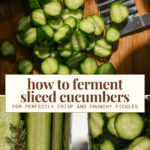
Tired of soggy fermented pickles? This fermented cucumbers recipe makes it easy to ferment crunchy and crisp pickles. Learn the best techniques for fermenting sliced cucumbers ready to eat in just two weeks!
- Prep: 20 minutes
- ferment: 2 weeks
Ingredients
- 460 grams cucumbers
- 320 grams water
- 28 grams sea salt
- 20 grams shallot, minced
- Fresh dill
- 1 thyme sprig
- 3 teaspoons pickle spices*
Instructions
- Please see the recipe notes before you begin.
- Wash all of your fermentation equipment (jar, weight and lid)
- Wash your cucumbers in cool water.
- Slice your cucumbers either as ripple cut chips or as spears/halves. Remove and discard the cucumber ends.
- Place your kitchen scale on the counter. Turn it on and set it to weigh in grams.
- Weigh out the designated amounts of all your ingredients.
- Add everything to the mason jar. (It helps if you put anything cut small, like shallots, below the cucumbers to keep them from floating)
- Add in any spices (If using dry spices, you can avoid them floating to the surface. Place the spices in a small piece of cheesecloth or tea bag and tie it closed. Nestle the little spice pouch at the bottom the the jar, under the cucumbers. By doing this, you will still get all the flavor from the spices, without anything floating.)
- Place the lid on the jar, and secure. Shake the jar vigorously for 2 minutes to dissolve all the salt.
- Remove the lid. Place your clean fermentation weight in the jar, making sure to submerge the cucumber pieces and weight fully in the liquid.
- Secure the lid to the jar (you don’t need to significantly tighten it; just close it).
- Let the cucumbers ferment for 14 days at room temperature. Set the jar in a glass dish to catch any spills.
- If you tighten the lid a lot, you should burp the jar daily when it is bubbling. It also helps to open up the jar daily to rinse the lid clean and re-submerge or scoop out any floating bits.
- After 2 weeks, remove the fermentation weight and smell and taste test. Your fermented pickles should smell pleasantly sour and taste tart and salty! (if it’s warmer in your kitchen you can taste test around 10 days).
- Too salty for you? Pour off half the brine into an empty jar and top off the pickles with apple cider vinegar! Shake to combine. Save the brine to make my probiotic pickled garlic or probiotic pickled onions.
- Store in the fridge. Please leave a review below if you love this fermented pickle recipe!
Notes
- Pickling, Persian, or cocktail cucumbers work best. Make sure they are small-diameter. Cucumber recommendations are in the first paragraph of this blog post.
- If your cucumbers have large seed cavities, scoop out the seeds and cut into spears.
- The timeline is adjustable based on temperature. Fermentation is faster at warm temperatures. You can taste test at 10 days and see how you like them.
- This recipe at 1x is for a 32- ounce jar.
- You can use fresh herbs only, or dry spices only, or a combination of both. CLICK HERE for My Easy Homemade Dill Pickle Spice Blend Recipe
- You can add other spices like allspice or clove for sweeter flavor profiles, or chili flakes for spice.
References
Production of GABA by Microorganisms
Formation of γ-aminobutyric acid (GABA) during the natural lactic acid fermentation of cucumber








What is the downfall of fermenting for greater than 14 days? I have some cucumbers from the garden that I wanted to trial with this, but we will be out of town during days 11-19. If I started them and was able to burp them during the first week as needed. maybe I could then use a pickle pipe while I was gone. Do you think it would sit too long?
Also, I am struggling to find coriander seeds anywhere? Any suggestions?
I get mine from starwest botanicals. You can leave them out.
there are no problems leaving them for 20 days. You can put them in the fridge on day 11 if you want. They will just be more sour if you leave them at room temperature longer. They should be done bubbling by day 11.
Thank you so much for sharing! Another favorite in our house now. I think we’ve made it 4 times now and they’re always gone within just a couple days of being done 🙂
Trying them this time as whole pickles!
Hello,
Can I add hot pepper slices? We love hot dills!!!!!!,
Thank you for sharing your knowledge…..
Thank you for your recipe. 1st time fermenter. Mom made pickles in a 20 gallon churn and they were the family favorite. I didn’t have oak or grape leaves so in one jar I’m testing tame blackberry leaves. Anxious to see the finished product. Also is there a method for longer term storage?
I long term store my fermented vegetable in the refrigerator.
Hi! I’m six days away from my first batch of pickles. I am so excited! They smell fantastic. I’ve already started my second batch. I doubt these will sit in the fridge long but I am wondering if they last six months in the fridge like sauerkraut or if their freshness is longer or shorter. Also, I’m one of those weirdos who can be seen standing in front of the fridge drinking the pickle juice. LOL! It’s SO good! Any problems with drinking this juice or just more probiotic goodness? Thanks a ton for this fantastic recipe!
They should last six months in the fridge just fine! I drink fermented pickle brine all the time! It’s great and full of probiotics. I suggest pouring into a little glass and drinking it, and not drinking it straight from the jar, though.
Would you do anything different if fermenting whole pickling cucumbers? I’m planning to try this recipe this summer.
No, you can follow the same directions for whole pickling cucumbers. Make sure to cut off the blossom end.
Kaitlynn, thank you for answering my previous question. My first batch is done and they are AMAZING!!! They are so flavorful and probably the best pickles I have ever tasted. Thank you! When my first batch was brewing there were lots of wonderful bubbles when I burped the jar but with my next batch, there is hardly any at all. Does that indicate a problem? Thank you for your guidance.
You’re welcome! I’m happy to hear you love the pickles!!! It’s not a problem, some cucumbers have a lot of bubble-producing microbes and some have less. As long as you see some bubbles it’s good to go. If you loved the recipe, can you leave a five-star review? Reviews are so helpful 🙂
I absolutely loved making these pickles! It was so much fun and much easier than I expected. My first batch came out so amazing and so flavorful, I’m on to the next couple of batches. I think these are the best-tasting pickles I have ever had and I am a pickle person. Thank you so much for the guidance and recipe!
Why is it recommended not to use the gasket with Weck jars?
You can use it, but if you leave it off and set the jar in a bowl, it allows the gas to escape, so you don’t need to burp the jar.
I am excited to make these! One question I couldn’t figure out from the blog – do I use both the fry pickle spices AND the thyme/minced shallot, or is it one or the other? The asterisk in the recipe confused me. Thanks so much for all these recipes!
Hi there! an asterisk next to an ingredient generally indicates that you should check the notes section of a recipe, under the instructions. The notes section has the info you’re looking for 🙂
Do you dissolve the salt first or just pour it in?
The directions are in the recipe card. See steps 10-12
Hello and thank you for your recipe! If the pickles just taste super salty, did I do something wrong? 😆 I also didn’t have “pickling spices” or anything so I’m not sure if that impacts the flavor.
So the taste of “saltiness” is different for everyone. What you think is super salty, someone else might think is regular. So you probably didn’t do anything wrong, you’re just not used to the flavor of naturally fermented pickles. You may also be tasting lactic acid flavor mixed with salt. Lacto-fermented pickles aren’t going to taste like vinegar pickles.
That’s good to know, thank you! I usually like things pretty salty so I was like yikes! I was worried I didn’t dissolve the salt or something went wrong. You’re right though, it could just be something to get used to. I had quite a bit of cucumbers this season, so I’ve been experimenting with a lot of techniques. Everything is definitely different homemade!
Hi, I have Melitta brand paper tea bags, would that work for spices? Thanks for all your recipes!
Cathy
yes those should work!
mine are currently fermenting!
i have marketmore cucumbers and Eureka pickle cucumbers that i’m growing from the farmers market.
i can’t tell which ones are which bc they all look the same. do you know if both of these will work?
i think i’m using the marketmore currently. i picked them when they were smaller.
i can’t wait to see what happens!
Hey there sleepy head… oops, I meant to say, lovely Kaitlynn.
I found your deliciously tempting Fermented Cucumbers recipe blog reading your email today. Which seems incredibly easy to do, super healthy and a delicious delight. I particularly love your microbiologist infused nuggets of really interesting and helpful information so a BIG thank you, Kaitlynn.
I’ve been learning as much as possible about fermentation and I must say, your microbiologist qualifications give me confidence, so much that I am keen to have a go for the very first time. I’ve never fermented before so this will be my very first time.
One thing that’s been holding me back is my severe OCD. I must literally wash everything many times with soap and water, including vegetables. My concern is, the fermentation process will not work because I suspect the friendly bacteria is washed away when washing the cucumbers with soap and water. Am I right in thinking this, what do you think, Kaitlynn?
Alternatively, if washing with soap as I do, discourages/prevents fermentation, do you know of another method to initiate fermentation?
Hey, kudos to your husband, Jon’s photography adds a lot of value and meaning to the concepts and information you are explaining.
Have a lovely day,
Julian
Hi there! Washing vegetables a lot can significantly reduce the wild fermentation microbes. But if washing things really well makes you more comfortable, you can keep doing so and try using a starter culture with my recipes! I suggest this one (link to vegetable fermentation starter cultures)
After washing the cucumbers with soap and water, I’m happy to report they fermented beautifully and taste delicious. Thanks, Kaitlynn 😃
So glad to hear this!
Thank you so much for this detailed post! Is it necessary to sterilize jars or will doing so kill off helpful bacteria? Can I pressure can these rather than storing in the fridge? Also, some recipes recommend fermenting for five weeks and others for 1 week. I am wondering why. Thanks!
You should clean all your equipment before getting started. I’ve never pressure-canned fermented vegetables, you would have to cook them, then hot pack them, then pressure can, and doing so will kill all the beneficial microbes. All my recipes have a different timeline based on the vegetables being fermented because all vegetables have a different microbiome and ferment at different rates.
The tool to scale the recipe is not working for me. Tried on my phone and iPad.
Thanks for letting me know! I’ll contact the recipe plug-in developer and see what’s up.
Hello and thank you for this recipe and all you do! I’m really excited to get started.
Would I be able to add in some peppers to make these a little spicy? Like a jalapeño or habanero? Trying to replicate my boyfriend’s favorite pickles. He’ll buy already fermented pickles and add the peppers to the container and keep in the fridge, but I’d like to ferment everything together. Based on your other blogs I’m wondering if the peppers would alter the process? Or should I add them in after fermentation when they’re going in the fridge?
I’m also generally wondering if I can add flavoring to this base recipe and just redo the calculations for the added things like garlic or onions or peppers etc?
Thank you in advance!
Thank you in advance!
You can add a few pepper pieces or a little garlic and onion without needing to change the recipe calculations. Just sub a bit of the cucumber weight with some peppers, garlic, and onion and it should be fine.
Perfect thank you!
Can I add some Fresno peppers and garlic, and just take the weight of peppers and garlic off the cucumber weight?
Many thanks 😊
I have made these and they came out like suggested yay! but I’m not used to the salty taste, is it possible after fermentation to swap half the brine for vinegar and store in the fridge in order to make it more palatable?
Also would doing this affect the amount of beneficial bacteria?